Login
Who's On Line
We have 204 guests and no members online
MailChimp Signup




Most Read Posts

When is Epiphany 2023? The date, meaning of Twelfth Night and traditions behind the feast day explained

When is Epiphany 2023? The date, meaning of Twelfth Night and traditions behind the feast day explained
On Friday 6 January many Christians will celebrate Epiphany – a feast day that has different meanings depending on the church you follow.

This date is preceded by Twelfth Night, considered the end of the Christmas period, and the day on which many take their trees and decorations down.
Here’s everything you need to know about the Epiphany, Twelfth Night, and how they are celebrated.
What is Epiphany?
Epiphany is a Christian feast day that always falls on 6 January.
It originated in the East where Christians celebrate the birth and baptism of Jesus. It is known as Theophany in the Eastern Orthodox tradition.
The Western Church began following it in the 4th century as the day the wise men were led by the star to visit baby Jesus, according to the story of the Nativity.
According to the Bible and to the Gospel of Matthew, the three wise men called Melchior, Caspar and Balthazar were drawn across the desert to meet the baby Jesus by the star of Bethlehem, and came bearing gifts of gold, frankincense and myrrh.
Protestant churches celebrate Epiphany as a season until Ash Wednesday, but in Roman Catholicism it is celebrated as a single day.
How Epiphany is celebrated varies depending on cultural beliefs and traditions, but in many countries it is a time to eat well and put away your Christmas decorations.
In France, people celebrate Le Jour des Rois, The Day of Kings, and children and adults enjoy la galette des Rois – or cake of kings. A tradition exists where the youngest of the family will go under the table and attribute each slice to someone randomly.
In Spain and some Latin American countries the holiday is marked with parades and another day off work.
In the Eastern Orthodox Christian religion, Christmas is celebrated on the date of Epiphany.
What is Twelfth Night?
The observance of Twelfth Night is widely considered to mark the coming of the Epiphany.
Different Christian traditions define the date of Twelfth Night as either the 5 or 6 of January, depending in part on how the 12 days of Christmas are calculated.
For many, Christmas Day marks the “first day”, which would give Twelfth Night its earlier date, while others believe the 12 days of Christmas begin on Boxing Day.
Matters are further confused by the consideration of whether Twelfth Night concludes the 12th day after Christmas itself, or falls the evening before.
But Professor Nick Groom, of the English department of the University of Exeter, who has researched Christmas traditions, concludes: “Twelfth Night is Twelfth Day’s Eve – we still talk about Christmas Eve as being Christmas Night.”
By that basis, Twelfth Night in 2023 would fall on Thursday 5 January this year.
Why do people take their Christmas decorations down on Twelfth Night?
According to tradition, Christmas trees and decorations should be taken down on either Twelfth Night or Epiphany to avoid bad luck after the season of merriment.
The belief has developed in modern times, with Professor Groom explaining: “It was basically the Victorians who decided that Christmas decorations should be taken down after 12 days because they wanted to get everybody to work.
“They fixed it as the season of Christmas in the 19th century.”
Indeed, before this unfortunate abridging of the festive season, the Tudors continued celebrating until 1 February.
This date marked the eve of Candlemas, a Christian festival marking the day the infant Jesus was presented to the God in the Temple at Jerusalem.
Reference: Story by Alex Finnis • Yesterday 16:27
Putin orders ceasefire in Ukraine over Orthodox Christmas - Kremlin
Putin orders ceasefire in Ukraine over Orthodox Christmas - Kremlin

MOSCOW (Reuters) -Russian President Vladimir Putin on Thursday ordered a 36-hour ceasefire in Ukraine over Orthodox Christmas, the first major truce of the more than 10-month long war that has killed tens of thousands and devastated swathes of Ukraine.
Putin ordered the ceasefire to begin on Jan. 6, the Kremlin said. Many Orthodox Christians, including those living in Russia and Ukraine, celebrate Christmas on Jan. 6-7.
Patriarch Kirill of Moscow called earlier on Thursday for both sides of the war in Ukraine to observe a Christmas truce.
"Taking into account the appeal of His Holiness Patriarch Kirill, I instruct the Minister of Defence of the Russian Federation to introduce a ceasefire regime along the entire line of contact of the parties in Ukraine from 12.00 on January 6, 2023 to 24.00 on January 7, 2023," Putin said in the order.
Statements from the Kremlin invariably use Russian time.
"Proceeding from the fact that a large number of citizens professing Orthodoxy live in the areas of hostilities, we call on the Ukrainian side to declare a ceasefire and allow them to attend services on Christmas Eve, as well as on Christmas Day," Putin said.
Ukraine earlier dismissed Kirill's appeal, though there was no immediate reaction to Putin's ceasefire announcement.
A senior aide to Ukrainian President Volodymyr Zelenskiy, Mykhailo Podolyak, cast the Russian Orthodox Church as a "war propagandist" that had incited the "mass murder" of Ukrainians and the militarisation of Russia.
"The statement of the Russian Orthodox Church about the 'Christmas Truce' is a cynical trap and an element of propaganda," he said.
(Reporting by Reuters; Editing by Andrew Heavens)
Archbishop of Canterbury condemns desecration of Christian graves in Jerusalem cemetery
Archbishop of Canterbury condemns desecration of Christian graves in Jerusalem cemetery
The Archbishop of Canterbury and the UK Government on Wednesday condemned the “blasphemous” desecration of Christian graves in Jerusalem, including a British soldier’s memorial.

Israeli police launched a hunt for the vandals after more than 30 gravestones in the Protestant Cemetery, south of Jerusalem’s Old City, were toppled and smashed on Sunday.
The attack came soon after Benjamin Netanyahu was sworn in as Israel’s prime minister alongside the most far-Right, religiously conservative government in the country’s history.
Justin Welby, the Archbishop of Canterbury, said: “The desecration of Christian graves in Jerusalem is a blasphemous act. I join the Chief Rabbi and religious leaders in Jerusalem in condemning it and hope those responsible will be brought swiftly to justice.”
The UK Government also condemned the vandalism, which is suspected to have been carried out by Jewish extremists.
Security footage showed what appears to be two youths, who were wearing the religious Jewish garments of the kippah and knotted tassels, smashing the graves.
“This is the latest in a string of attacks against Christians and their property in and around the Old City,” the Government consulate in Jerusalem in a tweet. “The perpetrators of religiously motivated attacks should be held accountable.”
‘Motivated by religious bigotry’
Hosam Naoum, Jerusalem’s Anglican Archbishop, said on Wednesday: “This really shows a clear hate crime towards Christians in Jerusalem, which we absolutely reject and condemn.” He also said there had been a recent increase in people spitting at Christians in Jerusalem.
Images from the cemetery on Wednesday showed that some gravestones had been split in two, including Commonwealth war graves.
The cemetery was established in 1848 and is watched over by Anglican and Lutheran communities in Jerusalem, where tensions have soared in recent weeks over the appointment of the new Israeli government with extremist elements.
Israeli police said they had inspected the damage and were investigating the attack. In a tweet, the Israeli foreign ministry said: “This immoral act is an affront to religion, and the perpetrators should be prosecuted.” No suspects had been detained or arrested as of Wednesday evening.
In a statement, the Anglican Church said it was likely that “these criminal acts were motivated by religious bigotry and hatred against Christians”.
A spokesman for the Commonwealth War Grave commission told the BBC the organisation was “appalled” by the incident, adding: “A very small number of CWGC headstones were damaged.
“We are co-operating closely with the authorities on the matter and our in-country staff are already working to carry out full repairs and return the graves to their normal condition.”
Reference: The Telegraph: Story by James Rothwell
Pope Benedict to be entombed in triple coffin made of cypress, zinc and oak
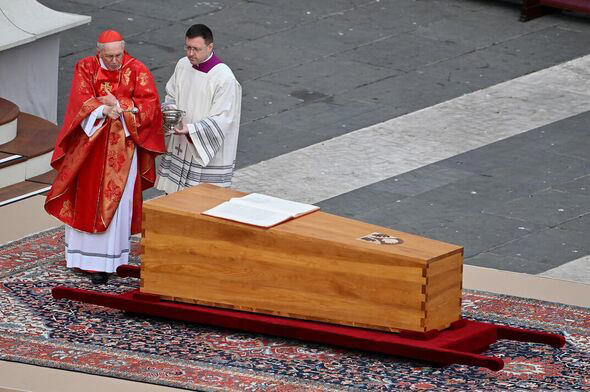
Pope Benedict to be entombed in triple coffin made of cypress, zinc and oak
Pope Benedict will be entombed in the crypt underneath St Peter's Basilica in three coffins made of cypress, zinc and oak, one placed inside the other, it has been confirmed. Earlier today, the Vatican released the official history of Benedict's life, a short document in Latin which was placed in a metal cylinder in his coffin before it was sealed, along with the various coins and medallions minted during his papacy and his pallium stoles.
The document gave ample attention to Benedict's historic resignation and referred to him as "pope emeritus," citing verbatim the Latin words he uttered on February 11, 2013, when he announced he would retire.
Known as a "rogito" or deed, the document also cited his theological and papal legacy, including his outreach to Anglicans and Jews and his efforts to combat clergy sexual abuse "continually calling the church to conversion, prayer, penance and purification".
The funeral ritual itself is based on the code used for dead popes, but includes some modifications due to the fact that Benedict was not a reigning pontiff when he died.
After the Mass, presided over by his successor Pope Francis, Benedict's cypress coffin will to be placed inside a zinc one, then an outer oak casket before being entombed in the crypt in the grottos underneath St Peter's Basilica, which once held the tomb of St John Paul II before it was moved upstairs.
Pope Francis Nd Pope Benedict
While the ritual is novel, it does have some precedent: in 1802, Pope Pius VII presided over the funeral in St Peter's of his predecessor, Pius VI, who had died in exile in France in 1799 as a prisoner of Napoleon.
Some 200,000 paid tribute to Benedict during three days of public viewing in the basilica, with one of the last, Friar Rosario Vitale, spending an hour praying by his body.
He said Benedict had given him a special dispensation to begin the process of becoming a priest, which was required because of a physical disability.
He added: "So today I came here to pray on his tomb, on his body and to say 'thank you' for my future priesthood, for my ministry."
Benedict never intended his retirement to last as long as it did at almost 10 years it was longer than his eight-year pontificate.
And the unprecedented situation of a retired pope living alongside a reigning one prompted calls for protocols to guide future popes emeritus to prevent any confusion about who is really in charge.
The relationship between the pair was explored in the 2019 film The Two Popes, starring Sir Anthony Hopkins as Benedict, and Jonathan Pryce as Francis.
Reference: Daily Express: Story by Ciaran McGrath
Articles-Latest
- Pope Leo's Travels 2026
- Donald Trump Insults Pope Leo
- Secrets of the Vatican
- Jews - Hebrews - Israelites - What is the Difference
- Easter Sunday Celebrations
- Job Beyond the Verses
- The Dark Fate of the Soldier who Crucified Jesus on the Cross
- What Happened to Jesus's 12 Apostles
- Book of Judges
- Fasting & Praying
- Pope Leo's Visit to Monaco
- Spiritual Warfare
- Prayers for Healing
- Night Prayers
- Prayers - To start your Day
- Palm Sunday 2026
- The 12 Tribes
- Revelations
- The Last Days
- The Book of Psalms
Articles-Most Read
- Home
- Plants that feel and Speak
- Let There Be Light
- The Singing Forest
- The Singing Forest-2
- Introduction
- Meditation
- Using Essential Oils for Spiritual Connection
- Making the Spiritual Connection
- Plants that Feel and Speak-2
- Heaven Scent
- Purification
- Anointing
- The Sanctity of Plants
- Essential Oils: The unseen Energies
- The Aroma Of Worship-Foreward
- Methods Of Use
- Spiritual Blending
- The Aroma Of Worship - Introduction
- Handling and Storage