Login
Who's On Line
We have 54 guests and no members online
MailChimp Signup




Most Read Posts

Mother Teresa of Calcutta (1910-1997)
 |
Mother Teresa of Calcutta (1910-1997)
“By blood, I am Albanian. By citizenship, an Indian. By faith, I am a Catholic nun. As to my calling, I belong to the world. As to my heart, I belong entirely to the Heart of Jesus. ”Small of stature, rocklike in faith, Mother Teresa of Calcutta was entrusted with the mission of proclaiming God’s thirsting love for humanity, especially for the poorest of the poor. “God still loves the world and He sends you and me to be His love and His compassion to the poor.” She was a soul filled with the light of Christ, on fire with love for Him and burning with one desire: “to quench His thirst for love and for souls.” This luminous messenger of God’s love was born on 26 August 1910 in Skopje, a city situated at the crossroads of Balkan history. The youngest of the children born to Nikola and Drane Bojaxhiu, she was baptised Gonxha Agnes, received her First Communion at the age of five and a half and was confirmed in November 1916. From the day of her First Holy Communion, a love for souls was within her. Her father’s sudden death when Gonxha was about eight years old left in the family in financial straits. Drane raised her children firmly and lovingly, greatly influencing her daughter’s character and vocation. Gonxha’s religious formation was further assisted by the vibrant Jesuit parish of the Sacred Heart in which she was much involved. |
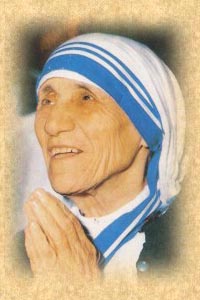
At the age of eighteen, moved by a desire to become a missionary, Gonxha left her home in September 1928 to join the Institute of the Blessed Virgin Mary, known as the Sisters of Loreto, in Ireland. There she received the name Sister Mary Teresa after St. Thérèse of Lisieux. In December, she departed for India, arriving in Calcutta on 6 January 1929. After making her First Profession of Vows in May 1931, Sister Teresa was assigned to the Loreto Entally community in Calcutta and taught at St. MaryÂ’s School for girls. On 24 May 1937, Sister Teresa made her Final Profession of Vows, becoming, as she said, the “spouse of Jesus” for “all eternity.” From that time on she was called Mother Teresa. She continued teaching at St. MaryÂ’s and in 1944 became the schoolÂ’s principal. A person of profound prayer and deep love for her religious sisters and her students, Mother TeresaÂ’s twenty years in Loreto were filled with profound happiness. Noted for her charity, unselfishness and courage, her capacity for hard work and a natural talent for organization, she lived out her consecration to Jesus, in the midst of her companions, with fidelity and joy.
On 10 September 1946 during the train ride from Calcutta to Darjeeling for her annual retreat, Mother Teresa received her “inspiration,” her “call within a call.” On that day, in a way she would never explain, Jesus’ thirst for love and for souls took hold of her heart and the desire to satiate His thirst became the driving force of her life. Over the course of the next weeks and months, by means of interior locutions and visions, Jesus revealed to her the desire of His heart for “victims of love” who would “radiate His love on souls.” “Come be My light,” He begged her. “I cannot go alone.” He revealed His pain at the neglect of the poor, His sorrow at their ignorance of Him and His longing for their love. He asked Mother Teresa to establish a religious community, Missionaries of Charity, dedicated to the service of the poorest of the poor. Nearly two years of testing and discernment passed before Mother Teresa received permission to begin. On August 17, 1948, she dressed for the first time in a white, blue-bordered sari and passed through the gates of her beloved Loreto convent to enter the world of the poor.
After a short course with the Medical Mission Sisters in Patna, Mother Teresa returned to Calcutta and found temporary lodging with the Little Sisters of the Poor. On 21 December she went for the first time to the slums. She visited families, washed the sores of some children, cared for an old man lying sick on the road and nursed a woman dying of hunger and TB. She started each day in communion with Jesus in the Eucharist and then went out, rosary in her hand, to find and serve Him in “the unwanted, the unloved, the uncared for.” After some months, she was joined, one by one, by her former students.
On 7 October 1950 the new congregation of the Missionaries of Charity was officially established in the Archdiocese of Calcutta. By the early 1960s, Mother Teresa began to send her Sisters to other parts of India. The Decree of Praise granted to the Congregation by Pope Paul VI in February 1965 encouraged her to open a house in Venezuela. It was soon followed by foundations in Rome and Tanzania and, eventually, on every continent. Starting in 1980 and continuing through the 1990s, Mother Teresa opened houses in almost all of the communist countries, including the former Soviet Union, Albania and Cuba.
In order to respond better to both the physical and spiritual needs of the poor, Mother Teresa founded the Missionaries of Charity Brothers in 1963, in 1976 the contemplative branch of the Sisters, in 1979 the Contemplative Brothers, and in 1984 the Missionaries of Charity Fathers. Yet her inspiration was not limited to those with religious vocations. She formed the Co-Workers of Mother Teresa and the Sick and Suffering Co-Workers, people of many faiths and nationalities with whom she shared her spirit of prayer, simplicity, sacrifice and her apostolate of humble works of love. This spirit later inspired the Lay Missionaries of Charity. In answer to the requests of many priests, in 1981 Mother Teresa also began the Corpus Christi Movement for Priests as a “little way of holiness” for those who desire to share in her charism and spirit.
During the years of rapid growth the world began to turn its eyes towards Mother Teresa and the work she had started. Numerous awards, beginning with the Indian Padmashri Award in 1962 and notably the Nobel Peace Prize in 1979, honoured her work, while an increasingly interested media began to follow her activities. She received both prizes and attention “for the glory of God and in the name of the poor.”
The whole of Mother Teresa’s life and labour bore witness to the joy of loving, the greatness and dignity of every human person, the value of little things done faithfully and with love, and the surpassing worth of friendship with God. But there was another heroic side of this great woman that was revealed only after her death. Hidden from all eyes, hidden even from those closest to her, was her interior life marked by an experience of a deep, painful and abiding feeling of being separated from God, even rejected by Him, along with an ever-increasing longing for His love. She called her inner experience, “the darkness.” The “painful night” of her soul, which began around the time she started her work for the poor and continued to the end of her life, led Mother Teresa to an ever more profound union with God. Through the darkness she mystically participated in the thirst of Jesus, in His painful and burning longing for love, and she shared in the interior desolation of the poor.
During the last years of her life, despite increasingly severe health problems, Mother Teresa continued to govern her Society and respond to the needs of the poor and the Church. By 1997, Mother Teresa’s Sisters numbered nearly 4,000 members and were established in 610 foundations in 123 countries of the world. In March 1997 she blessed her newly-elected successor as Superior General of the Missionaries of Charity and then made one more trip abroad. After meeting Pope John Paul II for the last time, she returned to Calcutta and spent her final weeks receiving visitors and instructing her Sisters. On 5 September Mother Teresa’s earthly life came to an end. She was given the honour of a state funeral by the Government of India and her body was buried in the Mother House of the Missionaries of Charity. Her tomb quickly became a place of pilgrimage and prayer for people of all faiths, rich and poor alike. Mother Teresa left a testament of unshakable faith, invincible hope and extraordinary charity. Her response to Jesus’ plea, “Come be My light,” made her a Missionary of Charity, a “mother to the poor,” a symbol of compassion to the world, and a living witness to the thirsting love of God.
Less than two years after her death, in view of Mother TeresaÂ’s widespread reputation of holiness and the favours being reported, Pope John Paul II permitted the opening of her Cause of Canonization. On 20 December 2002 he approved the decrees of her heroic virtues and miracles.
Reference: Vatican News:
In Pictures: Crowds gather to celebrate Beltain with burning of 40ft wicker man
In Pictures: Crowds gather to celebrate Beltain with burning of 40ft wicker man
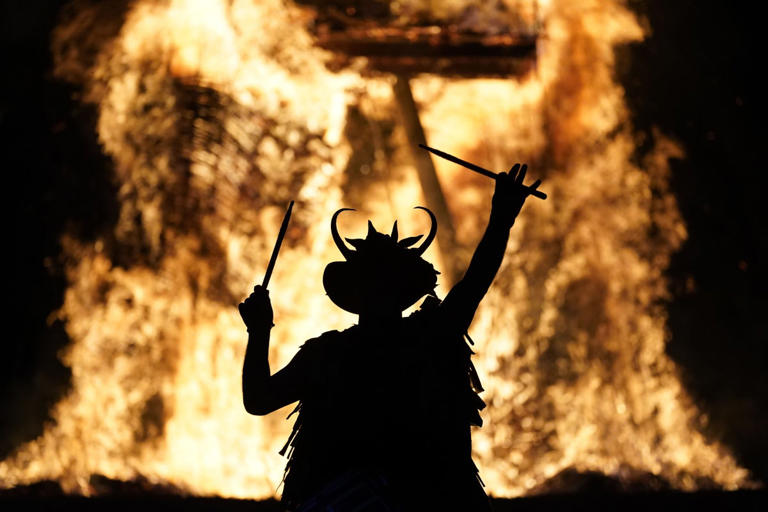
Crowds gathered to mark the coming of summer with a traditional Celtic fire festival held at Butser Ancient Farm in Hampshire.
The experimental archaeology site in Waterlooville hosted the burning of a 40ft wicker man at dusk to mark the pagan quarter-day farming celebration of Beltane or Beltain, which has connections to later May Day celebrations.
The May Queen and Green Man were in attendance, as were members of the Pentacle Drummers who performed in front of the burning wicker man.
- Story by Pa Reporter: Evening Standard:
How Christian Slaveholders Used the Bible to Justify Slavery
How Christian Slaveholders Used the Bible to Justify Slavery
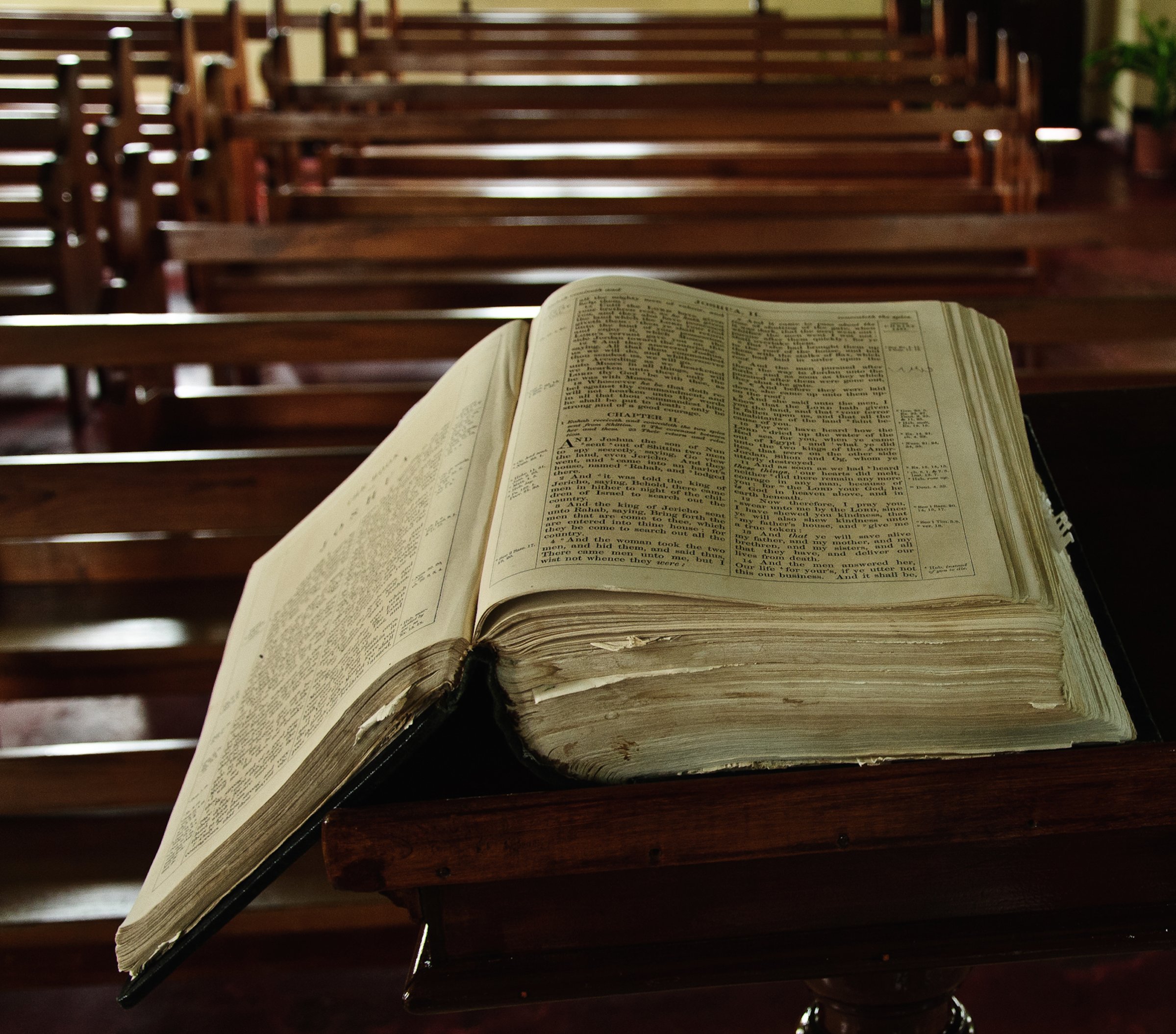
- During the period of American slavery, how did slaveholders manage
- to balance
- their religious beliefs with the cruel facts of the “peculiar institution“?
- As shown by the following passages — adapted from Noel Rae’s new
- book The Great Stain, which uses firsthand accounts to tell the story
- of slavery in America — for some of them that rationalization was
- rght there in the Bible.
- Out of the more than three quarters of a million words in the Bible,
- Christian slaveholders—and, if asked, most slaveholders would have
- defined themselves as Christian—had two favorites texts, one from
- the beginning of the Old Testament and the other from the end of
- the New Testament. In the words of the King James Bible, which
- was the version then current, these were, first, Genesis IX, 18–27:
-
- And the sons of Noah that went forth from the ark were Shem,
- Ham, and Japheth: and Ham is the father of Canaan. These
- are the three sons of Noah: and of them was the whole world
- overspread. And Noah began to be an husbandman, and he
- planted a vineyard: and he drank of the wine, and was drunken;
- and he was uncovered within his tent. And Ham, the father of
- Canaan, saw the nakedness of his father, and told his two
- brethren without.
- And Shem and Japheth took a garment, and laid it upon both
- their shoulders, and went backward, and covered the nakedness
- of their father; and their faces were backward, and they saw not
- their father’s nakedness.
- And Noah awoke from his wine, and knew what his younger son
- had done unto him. And he said, Cursed be Canaan; a servant of
- servants shall he be unto his brethren. And he said, Blessed be the
- Lord God of Shem; and Canaan shall be his servant. God shall enlarge
- Japheth, and he shall dwell in the tents of Shem; and Canaan shall
- be his servant. And Noah lived after the flood three hundred and
- fifty yearss.”
-
- Despite some problems with this story—What was so terrible
- about seeing Noah drunk? Why curse Canaan rather than Ham?
- How long was the servitude to last? Surely Ham would have
- been the same color as his brothers?—it eventually became
- the foundational text for those who wanted to justify slavery
- on Biblical grounds. In its boiled-down, popular version,
- known as “The Curse of Ham,” Canaan was dropped from
- the story, Ham was made black, and his descendants
- were made Africans.
- The other favorite came from the Apostle Paul’s Epistle
- to the Ephesians, VI, 5-7: “Servants, be obedient to them
- that are your masters according to the flesh, with fear
- and trembling, in singleness of your heart, as unto
- Christ; not with eye-service, as men-pleasers; but
- as the servants of Christ, doing the will of God from
- the heart; with good will doing service, as to the Lord,
- and not to men: knowing that whatsoever good thing
- any man doeth, the same shall he receive of the Lord,
- whether he be bond or free.” (Paul repeated himself,
- almost word for word, in the third chapter of his
- Epistle to the Colossians.)
- The rest of the Old Testament was often mined by pro-slavery
- polemicists for examples proving that slavery was common
- among the Israelites. The New Testament was largely ignored,
- except in the negative sense of pointing out that nowhere
- did Jesus condemn slavery, although the story of Philemon,
- the runaway who St. Paul returned to his master, was often
- quoted. It was also generally accepted that the Latin word
- servus, usually translated as servant, really meant slave.
- Even apparent abuses, when looked at in the right light,
- worked out for the best, in the words of Bishop William
- Meade of Virginia. Suppose, for example, that you have
- been punished for something you did not do, “is it not
- possible you may have done some other bad thing
- which was never discovered and that Almighty God,
- who saw you doing it, would not let you escape without
- punishment one time or another? And ought you not in
- such a case to give glory to Him, and be thankful that
- He would rather punish you in this life for your
- wickedness than destroy your souls for it in the next life?
- But suppose that even this was not the case—a case hardly
- to be imagined—and that you have by no means, known
- or unknown, deserved the correction you suffered;
- there is this great comfort in it, that if you bear it patiently,
- and leave your cause in the hands of God, He will reward
- you for it in heaven, and the punishment you suffer unjustly
- here shall turn to your exceeding great glory hereafter.”
- Bishop Stephen Elliott, of Georgia, also knew how to look
- on the bright side. Critics of slavery should “consider whether,
- by their interference with this institution, they may not be
- checking and impeding a work which is manifestly Providential.
- For nearly a hundred years the English and American Churches
- have been striving to civilize and Christianize Western Africa,
- and with what result? Around Sierra Leone, and in the
- neighborhood of Cape Palmas, a few natives have
- been made Christians, and some nations have been
- partially civilized; but what a small number in comparison
- with the thousands, nay,
- I may say millions, who have
- learned the way to Heaven and who have been made
- to know their Savior through the means of African slavery!
- At this very moment there are from three to four millions
- of Africans, educating for earth and for Heaven in the so
- vilified Southern States—learning the very best lessons
- for a semi-barbarous people—lessons of self-control,
- of obedience, of perseverance, of adaptation of means
- to ends; learning, above all, where their weakness lies,
- and how they may acquire strength for the battle of life.
- These considerations satisfy me with their condition,
- and assure me that it is the best relation they can,
- for the present, be made to occupy.”
- Reviewing the work of the white churches, Frederick
- Douglass had this to say: “Between the Christianity
- of this land and the Christianity of Christ, I recognize
- the widest possible difference—so wide that to receive
- the one as good, pure, and holy, is of necessity to reject
- the other as bad, corrupt, and wicked. To be the friend
- of the one is of necessity to be the enemy of the other.
- I love the pure, peaceable, and impartial Christianity
- of Christ; I therefore hate the corrupt, slave-holding,
- women-whipping, cradle-plundering, partial and
- hypocritical Christianity of this land. Indeed,
- I can see no rason but the most deceitful one
- for calling the religion of this land Christianity…”
- Adapted from The Great Stain: Witnessing American Slavery by Noel Rae.
- Copyright © 2018 by Noel Rae. Reprinted by arrangement with
- The Overlook Press, Peter Mayer Publishers, Inc.
- http://www.overlookpress.com. All rights reserved.
-
BY NOEL RAE : FEBRUARY 23, 2018 3:30 PM EST
Vatican excommunicates a former ambassador to the US and declares him guilty of schism
Vatican excommunicates a former ambassador to the US and declares him guilty of schism

ROME (AP) — The Vatican on Friday excommunicated its former ambassador to Washington after finding him guilty of schism, an inevitable outcome for Archbishop Carlo Maria Vigano. The conservative had became one of Pope Francis ' most ardent critics and a symbol of the polarized Catholic Church in the United States and beyond.
While once enjoying support in the Vatican and U.S. church hierarchies, the Italian archbishop alienated many as he developed a fringe following while delving deeper into conspiracy theories on everything — from the coronavirus pandemic to what he called the “Great Reset” and Russia's war in Ukraine.
The Vatican's doctrine office announced the penalty after a meeting of its members on Thursday and informed Vigano of its decision on Friday.
It cited Vigano's public “refusal to recognize and submit to the Supreme Pontiff, his rejection of communion with the members of the church subject to him, and of the legitimacy and magisterial authority of the Second Vatican Council.”
The excommunication, which Vigano incurred automatically with his positions, means he is formally outside communion with the church, and cannot celebrate or receive its sacraments. The crime of schism occurs when someone withdraws submission to the pope or from the communion of Catholics who are subject to him.
Unlike defrocking, a punitive measure that makes a priest a layman again, excommunication is considered a “medicinal” penalty and is declared in hope those who incurred it would repent and come back into communion. If that happens, the Holy See can lift the penalty.
Schisms, which have been regular in the church's 2,000-year history, are considered particularly dangerous as they threaten the unity of the church.
Vigano’s dire pronunciations about the current state of the church, amplified on Catholic social media and by ideologically friendly bloggers on both sides of the Atlantic, were an exaggerated version of the chasm between U.S. ultra-conservatives and Francis. And while Vigano enjoyed mainstream support among bishops early in his career, many quietly distanced themselves as his ideas became more extreme.
The Italian prelate, who has not been seen publicly since before 2018, knew the schism declaration was coming after the Vatican informed him of the penal process launched against him last month. He defiantly called it “an honor,” and refused to appear in person or defend himself or submit a written defense.
He did not directly respond to the schism declaration on Friday on X, his usual forum. Shortly before the Vatican decree was made public, he announced he would be celebrating a Mass on Friday for those who have been supporting him and asked for donations.
Vigano burst onto the public scene in 2012, during the first so-called Vatileaks scandal, when Pope Benedict XVI’s butler leaked the pontiff’s private papers to an Italian journalist to try to draw attention to corruption in the Holy See.
In some of the leaked letters, Vigano, then the No. 2 in the Vatican City State administration, begged the pope not to be transferred after exposing corruption in the awarding of Vatican contracts that cost the Holy See millions of euros (dollars).
The entreaties did not work. By the time the letters were published, Vigano was appointed the Vatican’s ambassador to the U.S. — a prestigious post but one that took him far from Rome and out of the running to one day be a cardinal.
Vigano reappeared on the scene during Francis’ 2015 visit to the U.S., which as nuncio he helped organize. Everything was going fine until Vigano arranged for Kim Davis, a Kentucky clerk at the center of the U.S. gay marriage debate, to be present at the Vatican residence to greet Francis, along with many other people.
After the visit, Davis and her lawyers claimed the encounter with Francis amounted to an affirmation of her cause denying marriage licenses to same-sex couples. The Vatican later turned the tables on Davis' claim, saying she had merely been among a group of well-wishers but that the “only” private audience Francis had in Washington was with a small group of people that included a gay couple.
But Vigano’s deception in inviting Davis to meet the pope put the prelate and the pontiff on a collision course that exploded in August 2018.
At the time, the U.S. church was reeling from a new chapter in its clergy sex abuse scandal: One of the most senior U.S. churchmen, Cardinal Theodore McCarrick, was accused of molesting a minor and a Pennsylvania grand jury issued a devastating investigation into decades of abuse and cover-up.
As Francis was wrapping up a tense visit to Ireland, Vigano published an 11-page screed accusing him and a long string of U.S. and Vatican officials of covering for McCarrick. Specifically, Vigano accused Francis of rehabilitating McCarrick from sanctions imposed by Pope Benedict, and called on him to resign — accusations that created the greatest crisis of Francis’ then-young pontificate.
Francis quickly authorized an in-house investigation into McCarrick. The report, released in 2020, confirmed that a generation of church officials, including Pope John Paul II, had turned a blind eye to McCarrick’s misconduct. It largely spared Francis, who eventually defrocked the churchman.
But the report also faulted Vigano for not looking into new claims against McCarrick or enforcing Vatican restrictions on him when specifically ordered to do so by the Vatican.
At that point, Vigano’s claims against Francis became more unhinged, endorsing conspiracy theories about the coronavirus vaccines, appearing at far-right U.S. political rallies via video, backing Russia in its war on Ukraine, and eventually, refusing to recognize Francis as pope.
Massimo Faggioli, a theologian at Villanova University, said while a good number of U.S. bishops vouched for Vigano's integrity when he first made his claims about McCarrick in 2018, his declarations in the ensuing years “led some of them to more prudent positions.”
In an essay in the French daily La Croix, Faggioli also noted that Vigano had had a seeming unintended effect of mainstreaming another schismatic group, the Society of St. Pius X, which also rejects the reforms of the Second Vatican Council, the 1960s meetings that modernized the church.
However, the society known as SSPX founded by the late French Archbishop Marcel Lefebvre in 1969, distanced itself from Vigano and his rejection of the legitimacy of Francis' pontificate, saying they “have not ventured down that perilous road.”
Vigano's positions make Lefebvre and the SSPX "look like right-of-center Catholics, and not like the extreme traditionalists they actually are," Faggioli wrote. "This says something about the ground shifting under the feet of Vatican II Catholics.”
- Story by NICOLE WINFIELD, Associated Press: The associated Press
Articles-Latest
- Pope Leo's Travels 2026
- Donald Trump Insults Pope Leo
- Secrets of the Vatican
- Jews - Hebrews - Israelites - What is the Difference
- Easter Sunday Celebrations
- Job Beyond the Verses
- The Dark Fate of the Soldier who Crucified Jesus on the Cross
- What Happened to Jesus's 12 Apostles
- Book of Judges
- Fasting & Praying
- Pope Leo's Visit to Monaco
- Spiritual Warfare
- Prayers for Healing
- Night Prayers
- Prayers - To start your Day
- Palm Sunday 2026
- The 12 Tribes
- Revelations
- The Last Days
- The Book of Psalms
Articles-Most Read
- Home
- Plants that feel and Speak
- Let There Be Light
- The Singing Forest
- The Singing Forest-2
- Introduction
- Meditation
- Using Essential Oils for Spiritual Connection
- Plants that Feel and Speak-2
- Heaven Scent
- Purification
- Making the Spiritual Connection
- Anointing
- The Sanctity of Plants
- Essential Oils: The unseen Energies
- The Aroma Of Worship-Foreward
- Methods Of Use
- The Aroma Of Worship - Introduction
- Spiritual Blending
- Handling and Storage