Login
Who's On Line
We have 192 guests and no members online
MailChimp Signup





Most Read Posts

Vatican ‘deplores the offence’ caused by Last Supper skit in Paris Olympics ceremony
Vatican ‘deplores the offence’ caused by Last Supper skit in Paris Olympics ceremony

The Vatican said it was “saddened by certain scenes” at the Paris Olympics opening ceremony which at one point appeared to parody the Last Supper with scantily dressed performers.
The scene performed on July 26 has angered Christian organisations for its apparent recreation of Leonardo da Vinci’s Last Supper with drag queens and a naked singer.
Although organisers defended the skit as a portrayal of a pagan feast led by Dionysus, the Greek god of wine, many remain unconvinced.
“The Holy See was saddened by certain scenes at the opening ceremony of the Paris Olympic Games and can only join the voices that have been raised in recent days to deplore the offence caused to many Christians and believers of other religions,” the Vatican said in a statement, originally in French.
“At a prestigious event where the whole world comes together to share common values, there should be no allusions ridiculing the religious convictions of many people. Freedom of expression, which of course is not in question, finds its limit in respect for others.”
Dancers and drag queens
The tableau, titled Festivity, began with a group of dancers and drag queens sitting around a long table. It was part of a section celebrating the French capital’s vibrant night life and reputation as a place of tolerance, pleasure and subversiveness.
Archbishop Vincenzo Paglia, head of the Vatican’s Pontifical Academy for Life, said the importance of the Olympics and its sporting values had been besmirched by “a blasphemous mockery of one of Christianity’s holiest moments”.Avvenire, an Italian newspaper affiliated with the Church, criticised the show in a lengthy editorial, saying: “What is the sense in transforming every event on the planet (even sporting) into a ‘gay pride’?”.
Matteo Salvini, Italy’s deputy prime minister and far-Right leader, described it as an insult to billions of Christians around the world while Tommaso Foti, the head of the Brothers of Italy in the lower house, condemned it as “blasphemy”.
The Last Supper is a mural painted by Leonardo da Vinci in the late 15th century in the Santa Maria delle Grazie convent in Milan. It depicts Jesus with the 12 apostles, showing the moment after he announced that one of them will betray him.
The organisers of the Paris Olympics last week apologised for any offence the scene caused. Anne Deschamps, a spokesman, said: “Clearly there was never an intention to show disrespect to any religious group.” The opening ceremony “tried to celebrate community tolerance”, she added.
- Story by Josephine McKenna: The Telegraph
Solomon's Law

Solomon's Law
Legal history or the history of law is the study of how law has evolved and why it has changed. Legal history is closely connected to the development of civilisations and operates in the wider context of social history. Certain jurists and historians of legal process have seen legal history as the recording of the evolution of laws and the technical explanation of how these laws have evolved with the view of better understanding the origins of various legal concepts; some consider legal history a branch of intellectual history. Twentieth-century historians viewed legal history in a more contextualised manner – more in line with the thinking of social historians.
They have looked at legal institutions as complex systems of rules, players and symbols and have seen these elements interact with society to change, adapt, resist or promote certain aspects of civil society.
Such legal historians have tended to analyse case histories from the parameters of social-science inquiry, using statistical methods, analysing class distinctions among litigants, petitioners and other players in various legal processes.
By analyzing case outcomes, transaction costs, and numbers of settled cases, they have begun an analysis of legal institutions, practices, procedures and briefs that gives a more complex picture of law and society than the study of jurisprudence, case law and civil codes can achieve.
Ancient world
Ancient Egyptian law, dating as far back as 3000 BC, was based on the concept of Ma'at, and was characterised by tradition, rhetorical speech, social equality and impartiality. By the 22nd century BC, Ur-Nammu, an ancient Sumerian ruler, formulated the first extant law code, consisting of casuistic statements ("if... then..."). Around 1760 BC, King
Hammurabi further developed Babylonian law, by codifying and inscribing it in stone. Hammurabi placed several copies of his law code throughout the kingdom of Babylon as stelae, for the entire public to see; this became known as the Codex Hammurabi.
The most intact copy of these stelae was discovered in the 19th century by British Assyriologists, and has since been fully transliterated and translated into various languages, including English, German and French. Ancient Greek has no single word for "law" as an abstract concept, retaining instead the distinction between divine law (thémis), human decree (nomos) and custom (díkē). Yet Ancient Greek law contained major constitutional innovations in the development of democracy.
United States
The United States legal system developed primarily out of the English common law system (with the exception of the state of Louisiana, which continued to follow the French civilian system after being admitted to statehood). Some concepts from Spanish law, such as the prior appropriation doctrine and community property, still persist in some US states, particularly those that were part of the Mexican Cession in 1848.
Under the doctrine of federalism, each state has its own separate court system, and the ability to legislate within areas not reserved to the federal government.
Modern European law
The two main traditions of modern European law are the codified legal systems of most of continental Europe, and the English tradition based on case law.
As nationalism grew in the 18th and 19th centuries, lex mercatoria was incorporated into countries' local law under new civil codes. Of these, the French Napoleonic Code and the German Bürgerliches Gesetzbuch became the most influential.
As opposed to English common law, which consists of massive tomes of case law, codes in small books are easy to export and for judges to apply. However, today there are signs that civil and common law are converging. European Union law is codified in treaties, but develops through the precedent set down by the European Court of Justice.
- Reference: Wikipedia - U Tube
Chief prosecutor defends Vatican's legal system after recent criticism of pope's absolute power
Chief prosecutor defends Vatican's legal system after recent criticism of pope's absolute power

ROME (AP) — The Vatican’s chief prosecutor has strongly defended the integrity and fairness of the city state’s justice system following criticism that Pope Francis' absolute power and his interventions in the so-called “trial of the century” last year violated the defendants’ fundamental rights.
Prosecutor Alessandro Diddi's defense comes as the Vatican tribunal finalizes its written reasonings for its December 2023 verdicts. The tribunal convicted a cardinal and eight others of various financial-related crimes related to the Holy See’s 350 million euro investment in a London property, but has not yet explained its decisions.
Diddi published an essay last month in a peer-reviewed Italian journal, “Law and Religion,” though he was not identified as the Vatican’s top criminal prosecutor in the online article. Legal experts said such a publication in an academic journal was unusual, since Diddi is a party to the trial.
He was essentially replying to two academics — and lawyers representing some of the 10 defendants — who have raised questions about whether the two-year trial and preceding investigation were fair.
Their critiques have raised questions about whether a fair trial is even possible in an absolute monarchy where the pope wields supreme legislative, executive and judicial power — and used it in this case.
Francis recently named several friendly cardinals — none with experience in Vatican law — to sit as judges on the Vatican's highest court of appeal and issued new rules on judges' salary and pension benefits.
In his essay, Diddi argued the trial and Vatican system itself were most certainly fair. He insisted that the tribunal and its judges were fully independent and that the defense had every opportunity to present its case. He said the pope’s four decrees merely filled regulatory loopholes in the Vatican's peculiar legal code and had no impact on the outcome of the trial or the rights of the defendants.
Diddi denied the decrees impacted the suspects’ rights. He said they merely provided an “authentic interpretation” by the pope to Vatican norms.
He argued that regardless, the decrees only “disciplined some particular aspects of the investigation,” and “and did not determine any failure in the guarantees offered to the suspects.”
Geraldina Boni, a canon lawyer who provided a legal opinion for the defense of Cardinal Angelo Becciu, has written that the decrees represented a clear violation of the right to a fair trial since the suspects didn't know about the broad powers granted to prosecutors. One defendant who came in for questioning was jailed for 10 days by prosecutors.
Diddi noted that Swiss and Italian courts have previously recognized the independence and impartiality of the Vatican City State's legal system in agreeing to provide judicial assistance in freezing assets of the suspects.
Those rulings, however, were issued before the current trial ended and the decrees' existence known. Additionally, a British judge ordered the assets of one of the suspects released because he found “appalling” misrepresentations and omissions in Diddi's case.
Questions about the fairness and impartiality of the Vatican City State’s legal system could have implications for the Holy See down the road, since the Vatican relies on other countries to cooperate in law enforcement investigations and implement its sentences.
Additionally, whenever the Holy See signs commercial contracts with non-Vatican entities, it insists that any contract dispute be handled by its own tribunal. That contractual clause could become difficult to negotiate if there are questions about whether the other side will be treated fairly by the Vatican court.
Less hypothetically, the Holy See is subject to periodic review by the Council of Europe’s Moneyval commission, whose evaluators analyze the effectiveness of the judicial system in fighting money laundering and terrorist financing.
In a related development, the Vatican’s No. 3 official on Monday wrapped up three days of testimony in a London court in a spinoff counter-suit brought by one of the Vatican defendants.
Raffaele Mincione, a London-based financier, is seeking to have the British High Court declare that he acted “in good faith” in his dealings with the Vatican over the London property. He is hoping to clear his name and repair the reputational harm he says he and his firm have endured as a result of the Vatican trial.
Mincione has also filed a complaint with the U.N. human rights office in Geneva, claiming that the pope violated his rights by authorizing surveillance via the decrees. The Vatican has rejected the claim, saying in a press statement that the investigation followed all relevant laws and international agreements and that no surveillance was actually ordered for Mincione.
Mincione, and the other defendants, have announced appeals.
- Story by NICOLE WINFIELD, Associated Press
Sacred Mysteries: The connection between E Nesbit and St Sebastian
Sacred Mysteries: The connection between E Nesbit and St Sebastian
The author of The Phoenix and the Carpet and The Railway Children, E Nesbit, married an impossible man. Edith fell for Hubert Bland, left home and was married in a register office. He gave a false address and didn’t tell his mother, for he had already had a son by her paid companion, Maggie.
When Edith discovered, she forgave him. She forgave him again when her best friend Alice came to care for her in an illness and became the mother of a daughter by Hubert. She passed off the girl as her own (as again with a son).
His fellow-socialist Bernard Shaw said Bland was “never seen without an irreproachable frock coat, tall hat, and a single eyeglass which infuriated everybody”. Bland said of himself: “All who knew him liked him except those who hated him.”
Edith wrote a couple of novels with Hubert under the pen name Fabian Bland, for in 1884 he had helped found the Fabian Society. It favoured socialism achieved by permeating existing structures, instead of by revolution This became the philosophy of the Labour Party.
Edith called a son born in 1885 Fabian, but he died suddenly in 1900, a loss she felt greatly. Then Hubert Bland died in 1914, having become a Catholic.
Edith then married a Cockney who never wore a collar, to the disapproval of her family. He was a Catholic too, though she never formally converted. They lived in two army huts on Romney Marsh. What a life she had!
I think few now appreciate that the Fabian Society, which is still going as a think-tank, was named after the Roman General, Quintus Fabius Maximus Verrucosus. He was called Verrucosus after the wart on his lip but he was also called Cunctator because of his delaying tactics in fighting Hannibal. The Fabian Society has been keeping its powder dry for 140 years.
Today is the feast of St Fabian, Bishop of Rome, martyred in 250. He was of the same family as the general 500 years before.
People complain about popes now – that they are too loose doctrinally or too hidebound. But things were a shambles in Fabian’s day. He was credited with reconciling rival factions in Rome that had followed either Pope Pontian or Hippolytus, an anti-Pope as far as can be made out. Both were martyred, perhaps together in exile, and martyrdom does a lot to make up for schismatic tendencies. The two share a feast day, August 13.
But during Pope Fabian’s reign a new imperial persecution broke out. Fabian was recorded as dividing Rome into seven deaneries, with notaries to collect information about the martyrs. He became a martyr himself on January 20 250 and was buried in the catacomb of Callixtus. The carved inscription on this tomb survives, cut in Greek characters.
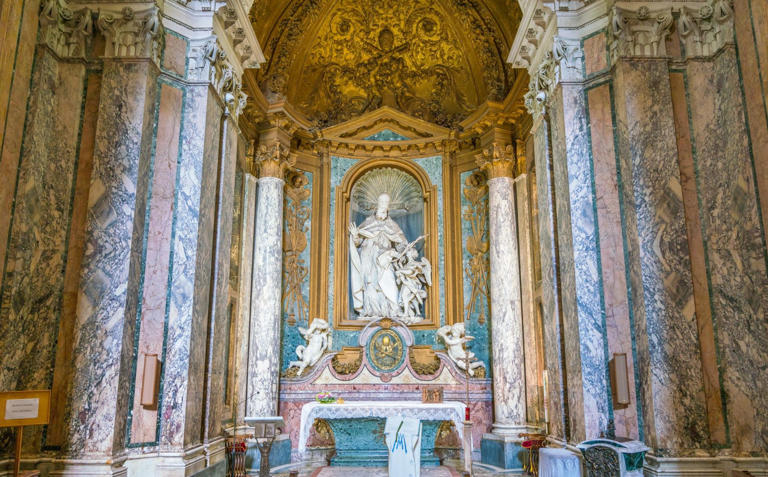
In the early 18th century, his remains were transferred to the church of St Sebastian without the Walls, a basilica rebuilt in the early 17th century above ancient catacombs. The facade is a modest Baroque structure that would hardly be noticed in Venice. It stands in a stone-walled nook like a farmyard on the old Via Appia.
Pope St Fabian’s altar is in the Albani chapel in the basilica. The sculpture nearby of the recumbent St Sebastian (whose feast also falls today) at his own altar owes something to Michelangelo’s Dying Slave and adumbrates the memorial to Shelley at University College, Oxford, with the addition of two or three arrows. St Fabian stands fully vested and triply tiara’d in high Renaissance style, assisted by three marble angels.
- Opinion by Christopher Howse
Articles-Latest
- Pope Leo's Travels 2026
- Donald Trump Insults Pope Leo
- Secrets of the Vatican
- Jews - Hebrews - Israelites - What is the Difference
- Easter Sunday Celebrations
- Job Beyond the Verses
- The Dark Fate of the Soldier who Crucified Jesus on the Cross
- What Happened to Jesus's 12 Apostles
- Book of Judges
- Fasting & Praying
- Pope Leo's Visit to Monaco
- Spiritual Warfare
- Prayers for Healing
- Night Prayers
- Prayers - To start your Day
- Palm Sunday 2026
- The 12 Tribes
- Revelations
- The Last Days
- The Book of Psalms
Articles-Most Read
- Home
- Plants that feel and Speak
- Let There Be Light
- The Singing Forest
- The Singing Forest-2
- Introduction
- Meditation
- Using Essential Oils for Spiritual Connection
- Plants that Feel and Speak-2
- Heaven Scent
- Purification
- Making the Spiritual Connection
- Anointing
- The Sanctity of Plants
- Essential Oils: The unseen Energies
- The Aroma Of Worship-Foreward
- Methods Of Use
- The Aroma Of Worship - Introduction
- Spiritual Blending
- Handling and Storage