Login
Who's On Line
We have 281 guests and no members online
MailChimp Signup





Most Read Posts

Justin Welby: The archbishop who battled depression due to ‘messy’ early life
Justin Welby: The archbishop who battled depression due to ‘messy’ early life
In his role as Archbishop of Canterbury, Justin Welby has presided over royal weddings and funerals – but he has also spoken of a “messy” early life and subsequent battle with depression.
Before being ordained in 1992, Mr Welby had an 11-year career in the oil industry.
He was installed as Archbishop of Canterbury in a service at Canterbury Cathedral in March 2013.
He also strongly criticised the previous Conservative government’s scheme to send asylum seekers who cross the Channel in small boats to Rwanda, which he warned was “leading the nation down a damaging path”.
A short time later he gave a speech hinting at his own experiences of being trolled online, speaking of the downsides of social media and hitting out at society’s “absolutely appalling” attitude to forgiveness in an apparent reference to cancel culture.
On that occasion, he said: “All of us know – I know especially at the moment, I’m not going to go into that one, I’m not going to go into debates in Parliament – but we know at the moment what it is to be trolled, to be threatened.”
Faith has acted as a “safety net” for the church leader, who has spoken of his personal experiences with depression which had led him to experience feelings of “self-hatred, self-contempt, real, vicious sense of dislike of oneself”.

As well as being a church leader in England, he is a spiritual leader to around 85 million people across the globe in what is known as the Anglican Communion.
He sits in the House of Lords and has been outspoken on political issues including child poverty – condemning the “cruel” two-child benefit policy – and assisted dying, the legalisation of which he has warned could lead to a “slippery slope”.
He also strongly criticised the previous Conservative government’s scheme to send asylum seekers who cross the Channel in small boats to Rwanda, which he warned was “leading the nation down a damaging path”.
A short time later he gave a speech hinting at his own experiences of being trolled online, speaking of the downsides of social media and hitting out at society’s “absolutely appalling” attitude to forgiveness in an apparent reference to cancel culture.
On that occasion, he said: “All of us know – I know especially at the moment, I’m not going to go into that one, I’m not going to go into debates in Parliament – but we know at the moment what it is to be trolled, to be threatened.”
Faith has acted as a “safety net” for the church leader, who has spoken of his personal experiences with depression which had led him to experience feelings of “self-hatred, self-contempt, real, vicious sense of dislike of oneself”.

In April 2023, in a series of lectures at Canterbury Cathedral to mark Holy Week, the archbishop said taking antidepressants had helped him to “react like an average sort of human being”.
Using a Winnie the Pooh analogy, he said antidepressants “restore me to Eeyore status from something much worse”.
In 2016, Mr Welby revealed that his biological father was the late Sir Anthony Montague Browne – Sir Winston Churchill’s last private secretary.
This had come as “a complete surprise” through DNA evidence, he said at the time, having believed his father was Gavin Welby, the man who raised him.
His mother, Lady Williams of Elvel, described the revelation as “an almost unbelievable shock”, but added she recalls going to bed with Sir Anthony “fuelled by a large amount of alcohol on both sides”.
In a statement at the time Mr Welby said: “I know that I find who I am in Jesus Christ, not in genetics, and my identity in him never changes.”
Gavin Welby died “as a result of the alcohol and smoking” in 1977, when the archbishop was 21, while Lady Williams died aged 93 in July 2023.

Lady Williams of Elvel (Fiona Hanson/PA) (PA Archive)
She had also battled alcoholism and Mr Welby has previously said that “as a result of my parents’ addictions my early life was messy”.
In October 2024, he revealed one of his ancestors owned slaves at a plantation in Jamaica.
He said a recent trip to the country “has helped me to confront the legacies of enslavement in the Caribbean”.
Mr Welby has also spoken lovingly of his own family, paying tribute to his “exceptionally precious” daughter Ellie, who is neurodiverse.
In his role as church leader, Mr Welby has been front and centre on major state occasions, not least the coronation of the King in 2023.

He anointed and crowned Charles, and admitted beforehand the thought was giving him “nightmares”, saying: “I dreamt we got to the point (of the coronation) and I’d left the crown at Lambeth Palace.”
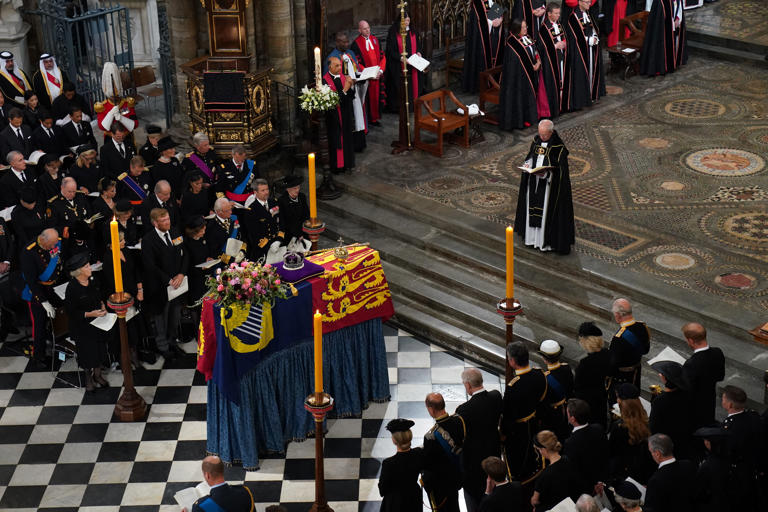
He had, in September the previous year, officiated the late Queen Elizabeth II’s funeral service, telling mourners at Westminster Abbey the monarch had touched “a multitude of lives” and was a “joyful” figure for many.
Mr Welby also officiated the wedding of the Duke and Duchess of Sussex in 2018 and has christened some of the royal children over the years.
Within the church, the archbishop has had to deal with division over the issue of same-sex blessings.
Following a vote in 2023 in favour of the move, an organisation representing some Anglican churches questioned his fitness to lead.
The Global South Fellowship of Anglican Churches (GSFA) criticised the passing of the motion, while others have consistently argued the church has not gone far enough and should allow same-sex marriage.
Mr Welby spoke a number of times during a lengthy Synod debate on the matter, and recognised there is “very painful” disagreement on the issue within the church.
His latest challenge has seen him face calls to resign in the wake of a report into a barrister thought to have been the most prolific serial abuser to be associated with the Church of England.
Critics say the findings of the Makin review, which concluded Mr Welby should have alerted authorities in the UK and Africa in 2013 to abuse committed by John Smyth, mean his position as archbishop has become untenable.
Mr Welby said the review had made clear that he “personally failed to ensure that after disclosure in 2013 the awful tragedy was energetically investigated”.
But he said while he had given resignation “a lot of thought”, he had taken advice from senior colleagues and has decided he will stay in post.
Story by Aine Fox: The Independent:
Who Was Potiphar in the Bible?
Who Was Potiphar in the Bible?
Proof that God even used slave-owners to accomplish His will
:max_bytes(150000):strip_icc():format(webp)/06.25.14Potiphar-56a096a05f9b58eba4b1d133.jpg)
The Bible is full of people whose stories are interconnected with the overarching story of God's work in the world. Some of these people are major characters, some are minor characters, and some are minor characters who had major parts to play in the stories of the major characters. Potiphar is part of the latter group.
Historical Information
Potiphar was involved in the larger story of Joseph, who was sold as a slave by his own brothers around 1900 B.C.—that story can be found in Genesis 37:12-36. When Joseph arrived in Egypt as part of a trade caravan, he was purchased by Potiphar for use as a household slave.
The Bible doesn't contain a lot of detailed information about Potiphar. In fact, most of what we do know comes from a single verse:
Meanwhile, the Midianites sold Joseph in Egypt to Potiphar, one of Pharaoh’s officials, the captain of the guard.
Genesis 37:36
Potiphar's Story
Joseph's arrived in Egypt under poor circumstances after being betrayed and abandoned by his own brothers. However, the Scriptures make it clear that his situation improved once he began work in Potiphar's household:
Now Joseph had been taken down to Egypt. Potiphar, an Egyptian who was one of Pharaoh’s officials, the captain of the guard, bought him from the Ishmaelites who had taken him there.
2 The Lord was with Joseph so that he prospered, and he lived in the house of his Egyptian master. 3 When his master saw that the Lord was with him and that the Lord gave him success in everything he did, 4 Joseph found favor in his eyes and became his attendant. Potiphar put him in charge of his household, and he entrusted to his care everything he owned. 5 From the time he put him in charge of his household and of all that he owned, the Lord blessed the household of the Egyptian because of Joseph. The blessing of the Lord was on everything Potiphar had, both in the house and in the field. 6 So Potiphar left everything he had in Joseph’s care; with Joseph in charge, he did not concern himself with anything except the food he ate.
Genesis 39:1-6
Potiphar's Story
These verses probably tell us more about Joseph than they do about Potiphar. We know that Joseph was a hard worker and a man of integrity who brought God's blessing into Potiphar's house. We also know that Potiphar was smart enough to recognize a good thing when he saw it.
Sadly, the good vibes didn't last. Joseph was a handsome young man, and he eventually caught the attention of Potiphar's wife. She attempted to sleep with him many times, but Joseph continually refused. In the end, however, the situation ended badly for Joseph:
11 One day he went into the house to attend to his duties, and none of the household servants was inside. 12 She caught him by his cloak and said, “Come to bed with me!” But he left his cloak in her hand and ran out of the house.
13 When she saw that he had left his cloak in her hand and had run out of the house, 14 she called her household servants. “Look,” she said to them, “this Hebrew has been brought to us to make sport of us! He came in here to sleep with me, but I screamed. 15 When he heard me scream for help, he left his cloak beside me and ran out of the house.”
16 She kept his cloak beside her until his master came home. 17 Then she told him this story: “That Hebrew slave you brought us came to me to make sport of me. 18 But as soon as I screamed for help, he left his cloak beside me and ran out of the house.”
19 When his master heard the story his wife told him, saying, “This is how your slave treated me,” he burned with anger. 20 Joseph’s master took him and put him in prison, the place where the king’s prisoners were confined.
Genesis 39:11-20
Some scholars believe Potiphar spared Joseph's life because he had doubts about the accusations leveled by his wife. However, there are no clues in the text that help us decide this question one way or another.
In the end, Potiphar was an ordinary man who did his duty in service to Pharaoh and managed his household in the best ways he knew how. His inclusion in Joseph's story may seem unfortunate—perhaps even a slight against God's character since Joseph remained faithful in his integrity throughout his enslavement.
Looking back, however, we can see that God used Joseph's time in prison to forge a connection between the young man and Pharaoh (see Genesis 40). And it was this connection that saved not only Joseph's life but the lives of thousands of people in Egypt and the surrounding regions.
- Reference: By Sam O'Neal
Ecclesiastes
Ecclesiastes - Who wrote the book?
The title “Ecclesiastes” comes from a Greek word indicating a person who calls an assembly, so it makes sense that the author identified himself in Ecclesiastes 1:1 by the Hebrew word qoheleth, translated as “Preacher.” Despite leaving only this rather mysterious name to indicate his identity, evidence in the book, along with most Jewish and Christian tradition, suggests that King Solomon authored Ecclesiastes.
The Preacher went on to call himself “the son of David, king in Jerusalem,” one who has increased in “wisdom more than all who were over Jerusalem before me,” and one who has collected many proverbs (Ecclesiastes 1:1, 16; 12:9). Solomon followed David on the throne in Jerusalem as the only Davidic son to rule over all Israel from that city (1:12). He was the wisest man in the world during his time (1 Kings 4:29–30) and wrote most of the book of Proverbs (Proverbs 1:1; 10:1; 25:1). Therefore, we can safely identify Solomon as the qoheleth of the opening verse.
Where are we?
With Solomon as the author of the book, we know it had to have been written sometime before his death in 931 BC. The content of Ecclesiastes reflects someone looking back on a life that was long on experience but short on lasting rewards. As king, he had the opportunity and resources to pursue the rewards of wisdom, pleasure, and work in and of themselves. Yet the world-weary tone of the writing suggests that late in life, he looked back on his folly with regret, pointing us to a better, simpler life lived in light of God’s direction (Ecclesiastes 12:13–14).
Why is Ecclesiastes so important?
Ecclesiastes presents us a naturalistic vision of life—one that sees life through distinctively human eyes—but ultimately recognizes the rule and reign of God in the world. This more humanistic quality has made the book especially popular among younger audiences today, men and women who have seen more than their fair share of pain and instability in life but who still cling to their hope in God.
What's the big idea?
Ecclesiastes, like much of life, represents a journey from one point to another. Solomon articulated his starting point early in the book: “Vanity of vanities! All is vanity” (Ecclesiastes 1:2), indicating the utter futility and meaninglessness of life as he saw it. Nothing made sense to him because he had already tried any number of remedies—pleasure, work, and intellect—to alleviate his sense of feeling lost in the world.
However, even in the writer’s desperate search for meaning and significance in life, God remained present. For instance, we read that God provides food, drink, and work (2:24); both the sinner and the righteous person live in God’s sight (2:26); God’s deeds are eternal (3:14); and God empowers people to enjoy His provision (5:19). Ultimately, the great truth of Ecclesiastes lies in the acknowledgment of God’s ever-present hand on our lives. Even when injustice and uncertainty threaten to overwhelm us, we can trust Him and follow after Him (12:13–14).
How do I apply this?
We all desire meaning in life. Often that search takes us along winding, up-and-down paths filled with bursts of satisfaction that shine bright for a time but eventually fade. In one sense, it’s satisfying to see that experience echoed throughout Ecclesiastes. An appreciation for our common humanity emerges from reading its pages. We relate to the journey of Solomon because, for so many of us, it is our own. When we attempt to find meaning in the pursuit of pleasure, the commitment to a job, or through plumbing intellectual depths, we all eventually find in each of these pursuits a dead end.
Ecclesiastes shows us a man who lived through this process and came out on the other side with a wiser, more seasoned perspective. When we’re surrounded by the temptation to proclaim life’s ultimate emptiness, we can find in Ecclesiastes a vision tempered by experience and ultimately seen through divinely colored lenses. Life is destined to remain unsatisfying apart from our recognition of God’s intervention. It only remains to be seen whether or not we will place our trust in His sure and able hands.
Have you struggled with misplaced pursuits in life? Does your life lack the meaning and purpose you desire? Hear the words of Solomon that they might encourage you to place your trust solely in the Lord.
Copyright ©️ 2009 by Charles R. Swindoll, Inc. All rights reserved worldwide.
Why Is it Important That Simon of Cyrene Carried the Cross?
Why Is it Important That Simon of Cyrene Carried the Cross?
Who Was Simon of Cyrene and What Does the Bible Say about him?
Everything recorded in the Bible is factual. From the truth of all reported words and events to the truth of Jesus as the Way and the Truth and the Life (John 14:6), the Bible wastes no words. The Holy Spirit superintended the words of Scripture to reflect God’s purposes, and everything it contains has meaning. Therefore, when we read short accounts of people, they are in the Word for a purpose. With that in mind, we should ask, “who was Simon of Cyrene and why is he mentioned in the Bible?”
Simon was, as written in Scripture, from Cyrene (Matthew, Mark, and Luke each say he was, “of” Cyrene), a city with a population close to 5,000 people. The Greeks made Cyrene a trade outpost ca. seventh century B.C., and it lay in the region of Cyrenaica, a coastal town on the Mediterranean Sea. As the Greeks expanded their empire, mythology guided them with names for new cities. Cyrene was named after Kyrene, the daughter of a Thessalian king (Hypseus), and a water nymph. Cyrene contained a number of Jewish settlers, and it is listed among the nations in Jerusalem on the day of Pentecost (Acts 2:10). People from Cyrene heard Peter preach is if in their own language.
Since Cyrene sat in modern-day Libya on the northern tip of Africa, many conclude Simon was a dark-skinned man, but we cannot know for sure because the Bible is not definitive about his race. Simon may have been African, but he could have been a transplanted Jew or of some other descent. Scripture does not say, and we must not assert something unintended by the writer of the Scriptures.
Simon of Cyrene is mentioned by name in only three passages of Scripture: Matthew 27:32, Mark 15:21, and Luke 23:26). In Matthew, it is said, “they found a man of Cyrene, Simon by name. They compelled this man to carry the cross.”Mark’s Gospel states, “they compelled a passerby, Simon of Cyrene, who was coming in from the country, the father of Alexander and Rufus, to carry His cross.” Luke says, “And as they led Him away, they seized one Simon of Cyrene, who was coming in from the country, and laid on him the cross, to carry it behind Jesus.”
Why Is it Important That Simon of Cyrene Carried the Cross?
Often in Scripture, the author gives or reveals why certain events and people are mentioned, be they lessons for believers today or to add substantiation to an account. The latter seems to be the case with Simon of Cyrene. He appears to be an aside to add interest to the story, but since the Lord wastes no words, his inclusion by the Gospel writers must have some import. In the whole of the Bible, not many people are named. That Simon is named gives credence to the account.
God is always purposeful, and He may have directed the soldiers to choose Simon of Cyrene to carry the Lord’s cross for a portion of His travail to Golgotha. We cannot lose sight of the fact that Immanuel (God with Us), the Creator (Colossians 1:16), the One Who carries our burdens (Psalm 55:22) accepted help from a man. What a lesson in humility. And we know that part of the execution process involved shameful, public humiliation. Simon did not merely spectate; he also partook in the Lord’s advance toward crucifixion.
If we imagine the scene along the way, we envision crowds taunting the Lord as He bears the weight of His cross. The people probably jostled each other to see the Christ go by, the One to Whom they so recently cried “Hosanna! Blessed is He who comes in the name of the Lord (Mark 11:9)! Isaiah says, “He was despised and rejected by men…He was despised, and we esteemed Him not” (Isaiah 53:3). Mixed within the scoffers were disciples, including John, and Jesus’ mother, and Mary Magdalene (John 19:25-26). Matthew and Mark say Simon “was compelled” to carry the cross, while Luke says Simon “was seized” and had the cross laid on him. In each account, Simon is pressed into service. The passages do not say he volunteered. In a manner of spiritualizing what Simon did, some say we, too, would rather not carry our “crosses.”
No matter who the Father chose to carry the cross for Jesus, that the soldiers pressed a man into service as a cross-bearer speaks to Jesus’ disfigurement and extremely weakened state. Was it pity that caused them to do it? We may never know. The soldiers had orders to get Jesus to Golgotha and face crucifixion and death. The Father appointed His Son to “death on the cross,” (Isaiah 53:10, Phil. 2:8), but the Roman soldiers would likely not have known the prophecies related to Jesus’ crucifixion and death. It’s possible, as they strode along with Him, that He, in His beaten state, may have looked ready to expire. Had that happened, the soldiers would have denied the mob their “spectator sport” of catcalls and a deathwatch as the crucifixion victims died on their crosses. The soldiers’ commanding officers expected them to carry out their complete orders, not let one of the men scheduled for crucifixion die before their duties were completed.
esus, in agony, while in the Garden of Gethsemane, cried out to the Father, “My Father, if it be possible, let this cup pass from Me; nevertheless, not as I will, but as You will” (Matthew 26:37-39). Simon’s service perhaps represents the Father’s act of love to His Son to temporarily ease Jesus’ burden. In God’s providence, His intentions are always accomplished—always. How kind of God to allow Simon a part in His Son’s last earthly journey (in His first advent).
Luke’s Gospel says Simon carried the cross “behind Jesus.” Some also spiritualize Simon’s conveyance of Jesus’ cross in relation to how we as believers are to “bear our own crosses” as we follow Jesus (Luke 14:27). Simon of Cyrene provides us with an implicit illustration of what that looks like. It’s not easy to follow Jesus. The world system tries to sway us with its distractions and enticements, just as Simon most likely received taunts and offers as he carried the Lord’s burden.
Believers today who seek to commemorate the various events along the way to Golgotha, including the spot where it is thought Simon of Cyrene was compelled to carry the cross, have chosen to walk the Via Dolorosa. It is during the walk one can pray and reflect on the Lord’s grueling struggle toward the Place of the Skull.
What Happened to Simon of Cyrene after the Resurrection?
Scripture makes no direct mention of Simon of Cyrene after the Resurrection. Tradition states Simon went to Egypt and shared the Gospel. After that, according to the apocryphal Acts of Simon and Judas, Simon was martyred in 100 A.D by being cut in half with a saw.
Cyrenians, however, are mentioned in Acts 6:9. They are of the group who disputed with Stephen as he did “great wonders and signs among the people” (Acts 6:8). Since Scripture makes no direct reference to Simon, we cannot assume he was in that same gathering.
Mark’s Gospel states Simon bore two sons (Rufus and Alexander). This fact does not assert the sons were with Simon, nor does it mean the Rufus mentioned in Romans 16:13 or the Alexander cited in 1 Timothy 1:20 or 2 Timothy 4:14 are Simon’s sons. Yet Mark references them for a reason of which we are not aware and may never be.
Simon was there. He carried the cross of Christ. All the facts as recorded in the Bible are written by God’s design (2Timothy 3:16-17).
May we all—with a remembrance of what Jesus did for us—bear our own crosses daily.
- Reference: Lisa Loraine Baker : Author of Someplace to Be Somebody
Articles-Latest
- Pope Leo's Travels 2026
- Donald Trump Insults Pope Leo
- Secrets of the Vatican
- Jews - Hebrews - Israelites - What is the Difference
- Easter Sunday Celebrations
- Job Beyond the Verses
- The Dark Fate of the Soldier who Crucified Jesus on the Cross
- What Happened to Jesus's 12 Apostles
- Book of Judges
- Fasting & Praying
- Pope Leo's Visit to Monaco
- Spiritual Warfare
- Prayers for Healing
- Night Prayers
- Prayers - To start your Day
- Palm Sunday 2026
- The 12 Tribes
- Revelations
- The Last Days
- The Book of Psalms
Articles-Most Read
- Home
- Plants that feel and Speak
- Let There Be Light
- The Singing Forest
- The Singing Forest-2
- Introduction
- Meditation
- Using Essential Oils for Spiritual Connection
- Plants that Feel and Speak-2
- Heaven Scent
- Purification
- Making the Spiritual Connection
- Anointing
- The Sanctity of Plants
- Essential Oils: The unseen Energies
- The Aroma Of Worship-Foreward
- Methods Of Use
- The Aroma Of Worship - Introduction
- Spiritual Blending
- Handling and Storage