Login
Who's On Line
We have 191 guests and no members online
MailChimp Signup




Most Read Posts

Plants that feel and Speak

Plants that feel and Speak
Chatting to plants is a regular occurrence, even for royalty, and some plant africionados play them music, taking care to choose something they like.
Edward Bach, famous for his Flower Remedies, attributed certain medicinal qualities to plants because the plants themselves told him what they were. An entire Western healing system is thus based on plant communication, and has inspired further plant-human exploration. meanwhile, in many cultures it is considered quite wrong to become a healer without first having had dreams or visions relating to the plants to be used. In other words, the spiritual realm is seen as the source of accurate information.
Cultures that are very much in touch with the earth and all that grows in it believe unreservedly that plants have a spirit. Obviously a plant is unable to speak, so to communicate with it we have to get in to the spiritual 'space' we share with it. If you want to know what a plant can do , go to the source and ask it.
To indigenous people s, that's the logical thing to do . There are variations on this cultural theme ; with some people believing the spirit of the individual plant conveys the information; or that each species of plant has a kind of 'overall' spirit which communicates; or that there are a variety of nature spirits; or that it is the voice of the creator that speaks. These are all variations on a theme: you can speak to, or through a plant.
The Yaqui people of northwestern Mexico have a oral tradition going back 4,000 years, to 2000 bc. Around AD 1500, because of the oppressive actions of the Spanish conquistadors, the Yaqui were forced to make their sacred traditions secret. Seven lineages were chosen to preserve them , through sacred oral and family traditions. Through many subsequent generations the sacred way of the Yaqui was kept alive underground, as the bullets flew overhead. Now that we are older and wiser, hopefully, the knowledge can re-emerge. Indeed, it is time for us to know it.
Cachora Guitemea is a man who carries this knowledge, passed to him by his father and mother. A Yaqui traditional spiritual healer, Cachora is a highly respected native American elder. It was, then a great privilege for me to be privately invited to spend a few days in the Mexican desert with Cachora to learn about sacred plant medicine.
We were accompanied by both our daughters and the mutual friend who introduced us. Although Cachora is over eighty and has white hair you would never guess his age - either from his appearance or from his extraordinary energy. His face is lit up with joy that defies time. And, despite his boyish love of jokes, you never forget that you are in the presence of great wisdom and positive intent.
Cachora teaches that we must respect plants. Permission must be sought from the plant before picking it, and if the plant is required for ceremonial purposes sacred chants and mantras are said aloud, in honor of the plant or tree. All plants have souls and spirits that guard and protect the species. It is not that every individual plant has its own, but that there is a species-spirit, which has a place within plant heirarchy, depending on the sacredness of the purpose the plant is put to.
Cachora is quite plain about the underlying principles of haling herbs. He says that healing takes place when a person connects into the plant spirit, becoming the plant, and understanding its personality. using spirit as the method of transference, the plant's energy or healing properties are transmitted to the person.
Once the spirit of a particular species has come to be known, and its use and purpose memorized, its strengths and weaknesses understood, then in times of ill-health, as body, mind and spirit are one, by calling on the spirit and taking into one's mind the spiritual essence of the plant, healing can take place.
Plant life must be respected and spoken to, says Cachora, for it is part of the universe, part of ourselves, our heritage. I understand this to mean that everyone evolved through a plant, and through the plant cycle of crystalline life - we are all part of the same consciousness pool. Getting to know plants involves looking at them closely, communicating with them with honesty and integrity, and with gentleness.
Human thought is the greatest obstacle to plant communication. You have to get beyond thought, into empathy and feeling, through focus and concentration. On this amazing journey I encountered a magnificent six-feet-high white sage bush, a grandfather of the species which, having seeded many generations of plants, was an elder in its own right. So vibrant was it that the leaves seemed to send showers of sparks, but I was rather taken aback when the large bush bowed its body to greet us. As there was not a hint of a breeze I turned to my friend beside me to verify what had happened. I could tell from her wide-open eyes that she could! Then the sage spoke to me, in a silent block of communication, clear and precise.
There are many indigenous peoples in the world who feel the spirit in nature , and work with it, Certain themes emerge. One such idea is that some plants should not be picked because they are too sacred. - too old and valuable to their 'tribe'. Just like us, plants need their wise elders. They say you should ask a plant if it is okay to pick it. A plant may say no, it may agree - and it is respectful to explain who the plant is for, and what is wrong with them. The plant will then know it is being needlessly sacrificed.
Another is the general idea that the spirit of the plant is a communal one, shared by the species as a whole, so that when you communicate with a plant you communicate with its species-spirit. When I spoke to the large sage bush I spoke to the spirit of the species, but through the wise old bush who happened to hold a great deal of communal species wisdom and could express more information more clearly.
Reference: Fragrant Heavens/ V. Worwood
The Singing Forest
The Singing Forest
The man walked deep into the forest for many days until he found a tree he thought might be the oldest. He planned to extract a sample using a core drill, to enable him to count its rings and date it, but the drill didn't work. For some days he tried to fix it, without success. He also had a saw and he looked at the tree; he thought about the long walk back to get another core drill, and about the importance of his research.
So he cut down the tree and dated it. It was 4,000years old enough to have lived through most of known human history. When Moses was a baby, this tree was already 500 years old.
People have different relationships with nature. Some, like the man in this story, don't treat it with the respect it deserves, making it a sacrifice to the human ego. Others claim that plants have intelligence, soul and the capacity to communicate, and would no more cut down an ancient tree than cut down a grandmother.
Attitudes differ. Some people hear the forest sing and some don't.
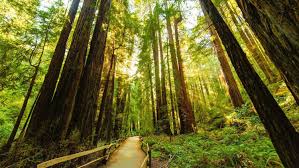
One hundred and forty million years ago most of the northern hemisphere was covered in redwood and other trees. mankind made its appearance maybe 200,000 years ago and has, especially in the last two hundred years, remorselessly cut the forest down.
As early as 1905 American Congressman William Kent, and his wife Elizabeth recognized the potential ecological danger, and bought 295 acres of redwood forest in California, for $45,000. naming it 'Muir Woods' after the conservationist John Muir. He wrote to the Kents 'you have done me a great honor, and I am proud of it'.
We owe thanks to them all because today 'Muir Woods' is one of the few remaining enclaves where you can stand amongst these magnificent trees without hearing the sound of a distant saw indictating that claer-out logging is heading your way.
It is a humbling experience to stand under ancient redwood trees . In Muir Woods I felt like a three year old in the presence of a vey large, old and wise men, in awe yet certain I would be completely protected . I did not want to leave their presence. Leaning on a Red Wood that extended too high into the sky for me to see its top, I felt the energy flooding into me, a cosmic river of refreshment for the soul.
I heard the drone of a distant saw but knew in this protected forest island it must only be someone cutting deadwood and undergrowth, to clear the ground. Even so, it reminded me of other areas of the world where international logging consortiums, are destroying huge areas of precious forest, and I felt an overwhelming emotion of sadness and guilt.
I apologised to the trees on behalf of human beings . Strange as it may seem the trees spoke to me, directly, without voice, from their heart to mine. They conveyed to me their resignation, deep sadness and incomprehension as to why we should want to do such things.To someone living in a large city, a long way away from trees, having a conversation with a tree might seem an odd thing to do. But when you are actually out amongst them it seems the most natural thing in the world. I can fully understand why traditional native Americans, when planning to cut down a tree to make a totem pole or boat, asked permission, and gave thanks directly to the tree making a sacrifice.
My love of trees started when I lived in Switzerland and used to take my dog for a walk in the forest late at night. When the moon and stars illuminated our path we walked on and on, for my pleasure rather than the gog's convenience as the silence and the makesty of the forest filled me with feelings of reassurance and gratitude.
It was there, high in the mouintains that I first sensed the living connection between the night sky, the trees and the earth. Many years later, in ancient and cedar forests in North America, this impression was reinforced. Standing under a thick canopy of stars illuminating the the sky, I sensed that trees, particularly very tall , ancient trees, act in some way as planetary antennae.
The very tops of the trees seem to attract starlight and other cosmic energies, 'earthing' that energy as it travels down through the trunk, into the roots and the earth. I also wonder if the trees don't also transmit information back into the sky, sending vibrational energy, including human thought energy, out into the cosmos. I have no scientific proof, of course, but the thought remains: these giant trees are recievers and transmitters jof energy, crucial even to cosmic balance and human spiritual growth.
Anyone who studies trees knows that there is still a great deal to learn about them, especially in terms of energy and communication. Even in terms of mechanics and chemistry, areas we think we know so much about , new discoveries are being made all the time. Scientists of British Columbia Ministry of Forests only recently found that certain tree species can share resources by using an underground network of fungal threads .
Seedlings of the Douglas fir, paper birch and western red cedar were subjected to carbon dioxide containing different carbo isotopes .
Two years later, 10 per cent of the carbon-type fed to the birch was found in the fir. Both species share mycorrhizal fungi, which created the network of threads between them, and the carbon travelled along this complete connection.
Because this same fungus dopes not connect with cedar, its particular experimental carbon composition was unaffected. Meanwhile in Kenya, scientists have discovered that a well as sucking water up from the deep earth 'substancial ' amounts of water is transported downwards by the trees, to the dry subsurface .
These are pretty fundemental discoveries, which tell us a great deal about the working of trees we did not know before, in an area - the mechanical - we thought we aready understood.
Reference: Fragrant Heavens/valerie Worwood
Let There Be Light

Let There Be Light
Walking through the woods, light filters through the leaves, creating a green haven of peace. The plants world is full of beautiful sights; there isn't a tree or flower that doesn't look good.
As each day dawn's pure sunlight sparkles in dew drops, shimmering on the grass, and on the leaves and flowers of the world. Walking through the woods, light filters through the leaves, creating a green haven of peace. The plant world is full of beautiful sights; there isn't a tree or flower that doesn't look good.
Although we think so sometimes, providing esthetic pleasure is not the most important thing about plants. By taking carbon dioxide and water from the air and, with light, converting it into carbohydrates , plants are the ultimate production machine, purifying the air and providing food and medicine for humans and animals alike. Plants are both the lungs and larder of the earth. They are the conduit between the light of the heavens, and the dark of the earth, channelling energy from the skin into crystalline structures of mother earth, to be reflected throughout the planet.
Plants are magnificent. The tallest tree in Redwood National Park, California, is the height of twenty-six London double-decker buses stacked on top of one another. These trees can live over 1'000 years, but even one only 800 years old has stood through the coronations and reigns of thirty-five kings and queens of England. The size and longevity of these master pieces of creation is humbling, but to actually walk amongst the immense trees of an ancient forest is more humbling still.
The smallest seed is awesome in its capacity to create another plant, perfect in every detail , including its store of seeds for future generations. Plant seeds have been found in archaeological sites and germinated, thousands of years after they were dropped - testament to the monumental capacity of tiny seeds to hold life.
Most of us live not in a living, breathing jungle but in a concrete one. We can redress this balance somewhat, by bringing the essence of plants - essential oils - into our homes, but to understand these fully we need to reacquaint ourselves with their heritage, their source - plants in their natural habitat.
Reference: Fragrant Heavens/ Valerie Worwood
Introduction

Introduction
Some spiritual traditions pay reverence to the whole living environment; others turn inward, and use specific mental exercises to connect with the oneness of the universe. Whether we pray to God, whether we pay homage to Mother Earth, Father Sky or the spirit of the sage, whether we look to the stars within, spirituality is about making connections. We may take different routes, but the destination is the same.
Although spiritual practices differ greatly, there's no coincidence in the fact that so many use fragrance. Every evening in India, the air is rich with the aroma of incense burning at home shrines. Smoke fragrant with the aroma of the smouldering resins, frankincense and myrrh, fills the air in Ethiopian Coptic and Orthodox Christian Churches. Muslins use lavish quantities of sweet-smelling rose water to impart fragrance to the mosques and other holy places.
{youtueb}
In native America sweat lodges, for ritual purification and spiritual connection, the fragrant herbs of sage, cedar and sweet grass are put on hot rocks to release their aroma molecules into the humid atmosphere. Clouds of fragrant smoke rise from the handful of incense sticks, placed at Chinese Buddist shrines. In the Havdallah ceremony held in Jewish homes at the close of the Sabbath every Saturday night, blessings for the light and fragrance are recited over the candle and spice box.
Each dawn, Tibetan go up on the roof s of their houses and light stoves in which they burn bundles of Juniper - to force the sky door open . As plumes of smoke rise from the houses and fragrance fills the air, prayers can be heard. It's the essential oils in fragrant plant materials, the aroma molecules, that are released by these various practices - they are what gives incense its aroma, just as the essential oil in pine needles gives a pine forest its uplifting quality.
Essential oils exude from plants into their 'headspace', where we smell them when walking amongst nature, and humans have devised many methods to capture this essence of the plant, the molecules so many people have chosen to help them connect with and feel the divine.
Fragrance has been said to alert the gods to out presence, and act as a sign that the human mind is focused and receptive to spiritual guidance. In many cultures sweet-smelling aroma was, and still is associated with divinity - with gods, heavens, angels and saints all being attributed a delightful fragrance. By being oneself fragrant, or burning fragrant material, a link or bridge could be formed to the divine. In Legends of the Bible Louis Ginzberg tells us that the Tabernacle had two altars: one brass, and used for food offerings, corresponding to the body; and one gold, used for offering spices and sweet incense - 'for the soul takes delight in perfumes only'.
Reference:/Fragrant heavens/V. A. Worwood
Articles-Latest
- Pope Leo's Travels 2026
- Donald Trump Insults Pope Leo
- Secrets of the Vatican
- Jews - Hebrews - Israelites - What is the Difference
- Easter Sunday Celebrations
- Job Beyond the Verses
- The Dark Fate of the Soldier who Crucified Jesus on the Cross
- What Happened to Jesus's 12 Apostles
- Book of Judges
- Fasting & Praying
- Pope Leo's Visit to Monaco
- Spiritual Warfare
- Prayers for Healing
- Night Prayers
- Prayers - To start your Day
- Palm Sunday 2026
- The 12 Tribes
- Revelations
- The Last Days
- The Book of Psalms
Articles-Most Read
- Home
- Plants that feel and Speak
- Let There Be Light
- The Singing Forest
- The Singing Forest-2
- Introduction
- Meditation
- Using Essential Oils for Spiritual Connection
- Making the Spiritual Connection
- Plants that Feel and Speak-2
- Heaven Scent
- Purification
- Anointing
- The Sanctity of Plants
- Essential Oils: The unseen Energies
- The Aroma Of Worship-Foreward
- Methods Of Use
- Spiritual Blending
- The Aroma Of Worship - Introduction
- Handling and Storage