Login
Who's On Line
We have 204 guests and no members online
MailChimp Signup





Most Read Posts

Archbishop of San Francisco performs exorcism ceremony at site of vandalized Saint Junipero Serra statue
Archbishop of San Francisco performs exorcism ceremony at site of vandalized Saint Junipero Serra statue
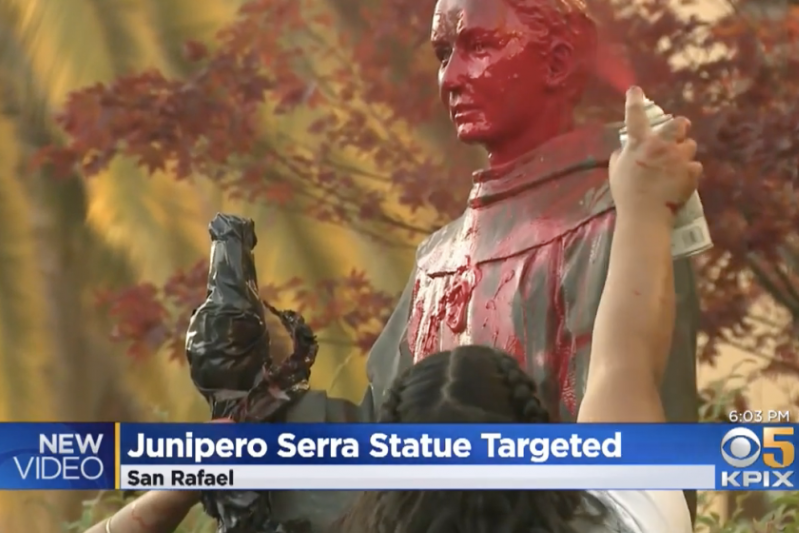
Armed with holy water and Latin prayers, Archbishop Salvatore Cordileone performed the ritual to "drive out evil and defend the image of Serra," the Los Angeles Times reports. As Cordileone explained to the crowd of 150 who'd assembled for the ceremony, "the experts in the field tell me that Latin tends to be more effective against the devil because he doesn't like the language of the church."
For those whose Latin was a little rusty, a translation of the proceedings was provided, and included prayers calling for Satan's "proud head" to be "crushed." "Be gone, Satan, inventor and master of all fallacy, enemy of the salvation of men. Place yourself before Jesus Christ," Cordileone ordered.
As the San Francisco Chronicle notes, despite the popular representation in The Exorcist, exorcisms are "more commonly a solemn ceremony like Saturday's, a religious ritual to evict the devil or evil spirits from an area or person."
Meanwhile, in the more earthly sphere, five people have been arrested on vandalism charges for knocking over the statue on Monday, which was both Columbus Day and Indigenous Peoples Day. Critics say Serra, a Spanish missionary priest, was a "brutal colonialist" who helped "to erase and destroy" the culture of native Californians, Vox writes. Cordileone defended Serra in the Saturday ceremony, saying the missions were "not to dominate and annihilate" but to save native Californians "from domination and annihilation" with the teachings of Catholicism.
The statue will be repaired, according to a spokeswoman for the Archdiocese of San Francisco.
Reference: The Week: Jeva Lange:
Police appeal after woman raped outside church in south east London

Police appeal after woman raped outside church in south east London
Detectives are appealing for information after a woman was raped in south-east London.
Police were called to Liverpool Grove in Southwark just after 4am on Saturday following reports of the attack.
The incident is understood to have taken place at around 3am in the grounds of St Peter’s Church.
Following the assault, the victim sought help from people in a nearby house, and police were called.
Investigations are ongoing.
Detective Constable Jake Good, of the Metropolitan Police, said: “This was clearly a very serious incident and we are carrying out a number of enquiries to identify the person responsible.
“I would ask that anyone who saw anything suspicious in the area at around that time to please come forward.
“Any detail – no matter how small – could assist with our investigation.”
Anyone with information is asked to contact 101 quoting Cad 1207/10Oct.
Reference: Evening Standard: Harriet Brewis; 1 day ago
Carlo Acutis: London-born 15-year-old moves closer to becoming first millennial saint
Carlo Acutis: London-born 15-year-old moves closer to becoming first millennial saint
A London-born 15-year-old has moved one step closer to becoming the first millennial saint.
In a service on Saturday in the Italian town Assisi, where he died with leukaemia in 2006, Carlo Acutis became the youngest contemporary person to be beatified.
This honour means the Catholic Church recognises his ability to intervene on behalf of those who pray in his name, and sets him another step further on the path to sainthood.
Already touted as “the patron saint of the internet”, Acutis taught himself to code from a textbook as a young boy, running websites for Catholic organisations and creating an online catalogue of purported miracles.
And earlier this year, Pope Francis approved a miracle attributed to Acutis himself, supposedly carried out some seven years after his death.
The Church claims Acutis intervened from heaven in 2013 to save the life of a seven-year-old boy in Brazil, whose rare pancreatic disorder was purportedly healed after coming into contact with a piece of one of Actutis’s old T-shirts.
During the beatification ceremony in Assisi’s St Francis Basilica, a portrait of Acutis was slowly unveiled, revealing a smiling teen in a red polo shirt, his curly dark hair illuminated by a halo of light.
His body, clad in a tracksuit and trainers, has been on display for veneration in a sanctuary in the town, and his heart will be displayed in the basilica.
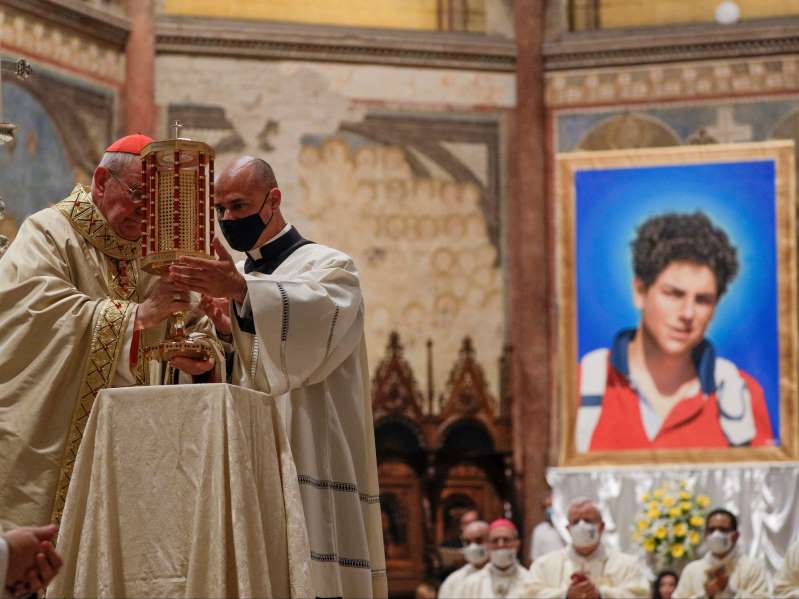
Cardinal Agostino Vallini kissed each of the boy's mask-wearing parents, Andrea Acutis and Antonia Salzano, after reading a proclamation decreed by Pope Francis.
“Carlo used the internet in service of the Gospel, to reach as many people as possible,” the cardinal said, adding that the teen saw the web “as a place to use with responsibility, without becoming enslaved”.
Born on 3 May 1991, Acutis moved to Milan as a three-year-old. Much to the surprise of his non-practicing parents, he soon showed an intense religious devotion and asked to be taken to visit the city’s churches, his mother told the Corriere della Sera newspaper.
By the age of seven, he asked to receive the sacrament of Holy Communion, and was granted an exception to the customary age requirement.
"There was in him a natural predisposition for the sacred," said his mother, who took up theological studies in order to better answer her son’s questions, reigniting her own faith. “It is a path that continues. I hope to at least wind up in purgatory,” Ms Acutis said.
His beatification puts him on a similar path to two Portuguese shepherd children, who had lived in the early 1900s and were proclaimed Catholic saints in 2017.
While sainthood typically requires the approval of at least two miracles, Pope Francis has been known to waive this requirement.
However, his mother believes he has already performed the requisite amount.
"I was sure he was already a saint while alive. He healed a woman from cancer, praying to the Madonna of Pompeii," Ms Acutis told Corriere.
“Before he left us, I told him: ‘If in heaven you find our four-legged friends, look for Billy’, my childhood dog that he never knew,” the mother added.
One day she reportedly received a call from an aunt who was unaware of their pact, who Ms Acutis said had told her: “I saw Carlo in a dream tonight. He was holding Billy in his arms.”
Reference: Independent: Andy Gregory: 1 day ago
Church of England forgave paedophiles and allowed them to continue working with children, inquiry finds

Church of England forgave paedophiles and allowed them to continue working with children, inquiry finds
The Church of England forgave paedophiles after they expressed remorse and allowed them to carry on working instead of protecting children, a report has found. The Independent Inquiry into Child Sexual Abuse (IICSA) said that between the 1940s and 2018, 390 clergy members or people in positions of trust were convicted of child sex offences. “The culture of the Church of England facilitated it becoming a place where abusers could hide,” said a report released on Tuesday.
“Deference to the authority of the Church and to individual priests, taboos surrounding discussion of sexuality and an environment where alleged perpetrators were treated more supportively than victims presented barriers to disclosure that many victims could not overcome.” IICSA said that many members of the church regard forgiveness “as the appropriate response to any admission of wrongdoing”.
The report cited the case of Timothy Storey, who was permitted to continue working with children after expressing “remorse for everything he had done wrong”. He is currently serving 15 years in prison for several offences against children, including rape. “Some religious leaders use ‘forgiveness’ to justify a failure to respond appropriately to allegations,” the report said.
“Perpetrators who repent must be willing to face the legal consequences of their sin and should be prevented from accessing environments in which re-offending could occur.” Evidence given to the inquiry suggested that some victims may have been pressured by church workers to forgive their abuser, causing further harm and potentially bringing them back into contact with the person.
“They may condemn themselves and believe they are condemned by others if they are not willing, or able to forgive,” the report said. It also raised concern about the seal of the confessional, which creates a “duty of absolute confidentiality” on the information disclosed. Diocesan safeguarding advisers said it was rare for someone to admit to child sexual abuse during confession, but survivor groups allege that numerous allegations have not been passed to authorities.
IICSA found that where formal complaints were made, alleged perpetrators were given more support by the Church of England than their victims, compounding their trauma. Storey received ongoing care and supervision from the Church throughout two court cases, the report said, while some of his victims “did not feel they were believed and felt on their own with no support”.
Allegations of him abusing girls as young as 13 he met through the Church dated back to 2007, when he was employed as a youth worker in the Diocese of London and for a missionary organisation. In 2009, he admitted to a senior vicar that he had sex with a 16-year-old girl whom he met through a residential Christian event, but the vicar told others that he “was basically a good man who could be an effective priest”.
After Storey was convicted for unrelated grooming offences in 2014, several other victims came forward and in 2016 he was jailed for three counts of rape and another sexual assault against girls he met through the Diocese of London.
IICSA’s report cited other cases where the Church’s response was “entirely inappropriate”. It said that after reverend Ian Hughes was convicted in 2014 for downloading 8,000 indecent images of children, including 800 in the most serious category, Bishop Peter Forster suggested he had been “misled into viewing child pornography”.
The inquiry found that public support had been given to some offending clergymen, including former bishop Peter Ball, who manipulated young men for his own sexual gratification in 2015. Lord George Carey, the former Archbishop of Canterbury, “simply could not believe the allegations against Ball ... and was outspoken in his support of his bishop”, the report said.
It cited “tribalism” as a key issue of concern in the Church of England, creating disproportionate loyalty that overrode child protection. “Perpetrators were defended by their peers, who also sought to reintegrate them into Church life without consideration of the welfare or protection of children and vulnerable adults,” IICSA said.
Other concerns highlighted were the power vested in the clergy, a culture of “deference” and lack of accountability to independent agencies. The inquiry warned of naivety among parishioners that the clergy’s moral code made sexual abuse unlikely or impossible, meaning reports were dismissed without investigation.
“The primary concern of many senior clergy was to uphold the Church’s reputation, which was prioritised over victims and survivors,” it added. “Senior clergy often declined to report allegations to statutory agencies, preferring to manage those accused internally for as long as possible. This hindered criminal investigations and enabled some abusers to escape justice.”
IICSA said a “culture of fear and secrecy within the Church about sexuality” had also fostered a climate of abuse, because paedophilia was wrongly conflated with homosexuality. The report, which contains eight recommendations, said that while improvements in child protection practice have been made there remains a long way to go to rebuild victims’ trust.
Professor Alexis Jay, chair of the inquiry said: “Over many decades, the Church of England failed to protect children and young people from sexual abusers. “If real and lasting changes are to be made, it’s vital that the Church improves the way it responds to allegations from victims and survivors, and provides proper support for those victims over time.
“The panel and I hope that this report and its recommendations will support these changes to ensure these failures never happen again.” A spokesperson for the Church of England said it was committed to introducing greater independent oversight and sharing safeguarding information externally.
It said a motion passed at the February sessions of the General Synod committed to a more victim-centred approach including arrangements for redress. “The report makes shocking reading and while apologies will never take away the effects of abuse on victims and survivors, we today want to express our shame about the events that have made those apologies necessary,” a statement added. "The whole Church must learn lessons from this Inquiry."
Reference: The In dependent: Lizzie Dearden 6 hrs ago
Articles-Latest
- Pope Leo's Travels 2026
- Donald Trump Insults Pope Leo
- Secrets of the Vatican
- Jews - Hebrews - Israelites - What is the Difference
- Easter Sunday Celebrations
- Job Beyond the Verses
- The Dark Fate of the Soldier who Crucified Jesus on the Cross
- What Happened to Jesus's 12 Apostles
- Book of Judges
- Fasting & Praying
- Pope Leo's Visit to Monaco
- Spiritual Warfare
- Prayers for Healing
- Night Prayers
- Prayers - To start your Day
- Palm Sunday 2026
- The 12 Tribes
- Revelations
- The Last Days
- The Book of Psalms
Articles-Most Read
- Home
- Plants that feel and Speak
- Let There Be Light
- The Singing Forest
- The Singing Forest-2
- Introduction
- Meditation
- Using Essential Oils for Spiritual Connection
- Making the Spiritual Connection
- Plants that Feel and Speak-2
- Heaven Scent
- Purification
- Anointing
- The Sanctity of Plants
- Essential Oils: The unseen Energies
- The Aroma Of Worship-Foreward
- Methods Of Use
- Spiritual Blending
- The Aroma Of Worship - Introduction
- Handling and Storage