Login
Who's On Line
We have 69 guests and no members online
MailChimp Signup




Most Read Posts

Africa's Catholic hierarchy refuses same-sex blessings, says such unions are contrary to God's will
Africa's Catholic hierarchy refuses same-sex blessings, says such unions are contrary to God's will
In the greatest rebuke yet to Pope Francis, the Catholic bishops of Africa and Madagascar issued a unified statement Thursday refusing to follow his declaration allowing priests to offer blessings to same-sex couples and asserting that such unions are “contrary to the will of God.”
The statement, signed by Congolese Cardinal Fridolin Ambongo on behalf of the symposium of African national bishops conferences, marked the closest thing to a continent-wide dissent from the declaration Francis approved Dec. 18 allowing priests to offer such blessings.
That declaration from the Dicastery for the Doctrine of the Faith has sent shock waves through the Catholic Church, thrilling LGBTQ+ Catholics as a concrete sign of Francis’ message of welcome but alarming conservatives who fear core doctrines of the church are being ignored or violated.
The controversy has deepened a growing chasm between Francis’ progressive, reform-minded papacy and the conservative church in much of the world, especially Africa, where the number of Catholics is growing at a faster rate than anywhere else.
The Vatican declaration restated traditional church teaching that marriage is a lifelong union between a man and woman. But it allowed priests to offer spontaneous, non-liturgical blessings to same-sex couples seeking God’s grace in their lives, provided such blessings aren’t confused with the rites and rituals of a wedding.
In his statement, Ambongo said it wasn’t appropriate for African priests to offer such blessings because of the scandal and confusion it would create. He cited biblical teaching condemning homosexuality as an abomination and the African cultural context, where he asserted that LGBTQ+ unions “are seen as contradictory to cultural norms and intrinsically corrupt.”
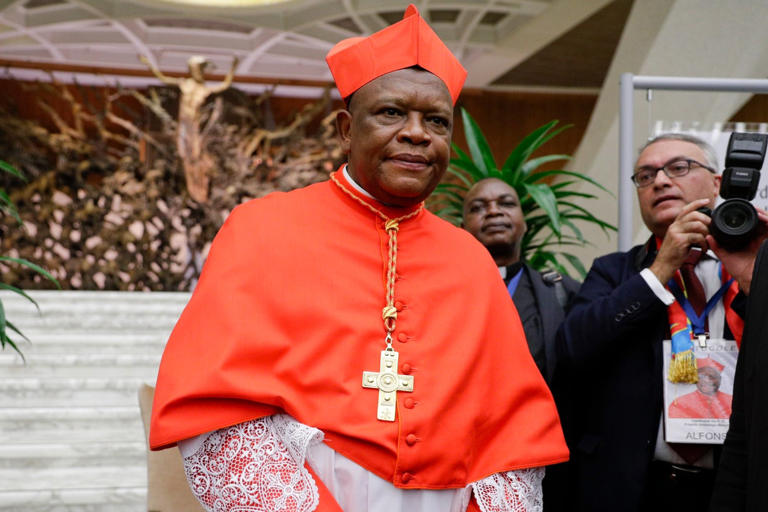
“Within the church family of God in Africa, this declaration has caused a shockwave, it has sown misconceptions and unrest in the minds of many lay faithful, consecrated persons and even pastors, and has aroused strong reactions,” he wrote.
While stressing that African bishops remain in communion with Francis, he said they believed such blessings cannot be carried out because “in our context, this would cause confusion and would be in direct contradiction to the cultural ethos of African communities.”
A few weeks ago, Burundi's President Evariste Ndayishimiye said “people of the same sex who marry in this country should be taken to a stadium to be pelted with stones, once discovered.” In a radio broadcast Dec. 29, he asked Burundians living abroad who practice homosexuality “not to return home.”
Ambongo said the symposium statement was a “consolidated summary” of the positions adopted by individual national bishops conferences, and said it had received the “agreement” of Francis and the doctrine office’s new prefect, Cardinal Victor Manuel Fernández.
The botched rollout of the Dec. 18 declaration has heightened conservative criticism of Fernández, whom Francis appointed to the office over the summer. Fernández apparently published the text with little consultation inside the Vatican and no forewarning to bishops in the rest of the world.
Usually, when such sensitive Vatican documents are being prepared, there is an attempt to at least not blindside local church leaders. Often they are released with an accompanying letter or explanatory note published by Vatican Media, and are given to journalists ahead of time under an embargo to ensure the reporting is accurate and thought through.
No such extra documentation or preparation accompanied Fiducia Supplicans, as the text is known, and its rollout was marked by individual bishops and entire national conferences voicing confusion and opposition.
Others have welcomed it. France’s bishops conference, for example, said in a statement Wednesday that the declaration encourages pastors to “generously bless the people who come to them humbly asking for God’s help."
The document “reminds us that those who are not in a position to commit themselves to the sacrament of marriage are not excluded from the love of God or of his church,” the French bishops said.
After its initial publication, Fernández was forced to issue a second explanatory note a few weeks later, insisting there was nothing “heretical” in the document but acknowledging the opposing views. He acknowledged that it may not be applicable to some parts of the world and that further “pastoral reflection” might be necessary.
- Story by Nicole Winfield; The Independent:
After decades of struggle for a place in Israel, dozens of Black Hebrews face threat of deportation
After decades of struggle for a place in Israel, dozens of Black Hebrews face threat of deportation
The African Hebrew Israelites of Jerusalem made their way to Israel from the United States in the 1960s
For two years, Toveet Israel and dozens of other residents of the Village of Peace have lived in fear.
Dimona, a city on the edge of the nation of Israel’s Negev Desert, has been her home for 24 years. Her eight children were born here and know no other country. Now, she and 44 other undocumented members of the African Hebrew Israelites of Jerusalem face deportation.
Receiving the order to leave two years ago was a “moment of disbelief” for Israel, 53. “I feel like the government has been merciless to me and my children,” she said.
The Black Hebrews, as the spiritual community's members are commonly known, first made their way to Israel from the United States in the 1960s. While members do not consider themselves Jewish, they claim an ancestral connection to Israel.
Around 3,000 Black Hebrews live in remote, hardscrabble towns in southern Israel. The Village of Peace, a cluster of low-slung buildings surrounded by vegetable patches and immaculate gardens in Dimona, is the community’s epicenter.
Over the decades, the Black Hebrews have made gradual inroads into Israeli society. After years of bureaucratic wrangling, about 500 members hold Israeli citizenship, and most of the rest have permanent residency.
But about 130 have no formal status and now face deportation. Some don’t have foreign passports and say they have spent their entire adult lives in Israel and have nowhere to go.
The community’s long fight to secure its status shines a light on Israel’s strict immigration policy, which grants people it considers Jewish automatic citizenship but limits entry to others who don’t fall under its definition.
The African Hebrew Israelites are one of a constellation of Black religious groups in the U.S. that emerged in the late 19th and 20th centuries and encompass a wide spectrum of Christian and Jewish-inspired beliefs.
Some fringe Black Hebrew groups in the U.S. hold extremist or antisemitic views, according to civil rights groups ADL and the Southern Poverty Law Center. The community in Dimona does not espouse such beliefs.
Reference: U Tube: The Independent
Purgatory in the Bible
Purgatory in the Bible
- Furthermore, entrance into Heaven demands this momentary suffering due to sins whose guilt has not been forgiven.
- Therefore, no one in purgatory will stay there forever nor go to hell. Discover mentions of purgatory in the Bible from the collection of scripture quotes below!
- Compiled by The BibleStudyTools Staff on 07/23/2018
Pope’s new ruling on blessings for same-sex couples does not change Catholic teaching - bishop
Pope’s new ruling on blessings for same-sex couples does not change Catholic teaching - bishop

Catholic bishop of Raphoe Alan McGuckian has rejected claims that Pope Francis’s declaration on blessing people in same-sex relationships is a change in church teaching on marriage and sexuality.
On Monday, Pope Francis published a document which set out the way in which a priest could impart a blessing to people in a same-sex relationship.
The pontiff stressed that such a blessing should not be confused with ritual or Catholic marriage, but said that in some circumstances individuals could be blessed.
The declaration re-affirmed that marriage was a lifelong sacrament between and man and a woman. However, some observers claimed the document marked a major change in Catholic teaching. The Pope’s document has also led to some Catholic bishops around the world issuing statements in opposition.
Bishop McGuckian, who like the Pope is a member of the Jesuit order, said the document was consistent with Pope Francis’s desire that the church reaches out “with mercy and love of Jesus” to everyone.
He said: “Some people are suggesting that this document heralds a change in the church’s teaching about marriage and sexuality. This is not the case.”
The Donegal church leader said Pope Francis’s document also sought to be consistent with the tradition which the Catholic church believed came from Jesus Christ. He pointed out that the Pope said no “liturgical blessing” could be given.
“What is envisaged here is an informal pastoral blessing, a prayer for divine grace to help people live their Christian lives ever more fully in line with the Gospel and to build on all that is good, true and beautiful in their lives. We are all sinners on the journey of conversion.”
Bishop McGuckian urged Catholics to read the document which, he said, contained “the tension between truth and mercy”.
“On the one hand it is a clear reaffirmation of the church’s teaching with an encouragement that nothing should be done that would lead to confusion about that. At the same time, it seeks to remind people who are living the Christian life in a less perfect way – that includes all of us – that God’s love never leaves us, while it always calls us to conversion,” Bishop McGuckian said.
- Story by Seamus McKinney • 4d: The Irish News:
Articles-Latest
- Pope Leo's Travels 2026
- Donald Trump Insults Pope Leo
- Secrets of the Vatican
- Jews - Hebrews - Israelites - What is the Difference
- Easter Sunday Celebrations
- Job Beyond the Verses
- The Dark Fate of the Soldier who Crucified Jesus on the Cross
- What Happened to Jesus's 12 Apostles
- Book of Judges
- Fasting & Praying
- Pope Leo's Visit to Monaco
- Spiritual Warfare
- Prayers for Healing
- Night Prayers
- Prayers - To start your Day
- Palm Sunday 2026
- The 12 Tribes
- Revelations
- The Last Days
- The Book of Psalms
Articles-Most Read
- Home
- Let There Be Light
- Plants that feel and Speak
- The Singing Forest
- The Singing Forest-2
- Introduction
- Meditation
- Using Essential Oils for Spiritual Connection
- Plants that Feel and Speak-2
- Heaven Scent
- Purification
- Making the Spiritual Connection
- Anointing
- Essential Oils: The unseen Energies
- The Sanctity of Plants
- The Aroma Of Worship-Foreward
- The Aroma Of Worship - Introduction
- Methods Of Use
- Spiritual Blending
- Handling and Storage